MCQ
One curie is equal to:
- A3.7 × 1010 Disintegration/ sec.
- B3.2 × 108 Disintegration/ sec.
- C2.8 × 1010 Disintegration/ sec.
- DNone of these.
Generate a complete, print-ready paper with questions like this in minutes — across 16+ boards, with answer keys.
An electric lamp is marked 60 W, 230 V. The cost of a 1 kWh of energy is Rs. 1.25. The cost of using this lamp 8 hrs a day for 30 day is
|
(a) Rs. 10 |
(b) Rs. 16 |
(c) Rs. 18 |
(d) Rs. 20 |
When an unpolarized light of intensity  is incident on a polarizing sheet, the intensity of the light which does not get transmitted is
|
(a) Zero |
(b) |
(c) |
(d) |
A bulb rated at (100W – 200V) is used on a 100V line. The current in the bulb is
|
(a) |
(b) 4 amp |
(c) |
(d) 2 amp |
The figure below shows the north and south poles of a permanent magnet in which n turn coil of area of cross-section A is resting, such that for a current i passed through the coil, the plane of the coil makes an angle θ with respect to the direction of magnetic field B. If the plane of the magnetic field and the coil are horizontal and vertical respectively, the torque on the coil will be
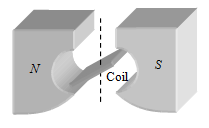
|
(a) τ = niAB cosθ |
|
(b) τ = niAB sinθ |
|
(c) τ = niAB |
|
(d) None of the above, since the magnetic field is radial |
A capacitor having capacitance C is charged to a voltage V. It is then removed and connected in parallel with another identical capacitor which is uncharged. The new charge on each capacitor is now
|
(a) CV |
(b) CV / 2 |
(c) 2 CV |
(d) CV / 4 |


