Question
One end of a long string of linear mass density $8.0 \times 10^{–3}kg m^{–1}$ is connected to an electrically driven tuning fork of frequency $256Hz$. The other end passes over a pulley and is tied to a pan containing a mass of $90kg$. The pulley end absorbs all the incoming energy so that reflected waves at this end have negligible amplitude. At $t = 0$, the left end (fork end) of the string $x = 0$ has zero transverse displacement $(y = 0)$ and is moving along positive y-direction. The amplitude of the wave is $5.0cm$. Write down the transverse displacement y as function of x and t that describes the wave on the string.
Answer

The equation of a travelling wave propagating along the positive y-direction is given by the displacement equation: $\text{y}(\text{x, t})=\text{a}\sin(\text{wt}-\text{kx})\ \dots(\text{i})$ Linear mass density, $\mu=8.0\times10^{-3}\text{kg m}^{-1}$ Frequency of the tuning fork, ν = 256Hz Amplitude of the wave, a = 5.0cm = 0.05m …(ii) Mass of the pan, m = 90kg Tension in the string, T = mg = 90 \times 9.8 = 882N The velocity of the transverse wave v, is given by the relation: $\text{v}=\sqrt{\frac{\text{t}}{\mu}}$
$=\frac{882}{8.0\times10^{-3}}=332\text{m/s}$ Angular Frequency, $\omega=2\pi\text{v}$
$=2\times3.14\times256$
$=1608.5=1.6\times10^3\text{ rad/s}\ \dots(\text{iii})$ Wanelength, $\lambda=\frac{\text{v}}{\text{v}}=\frac{332}{256}\text{m}$
$\therefore$ Propagation constant, $\text{k}=\frac{2\pi}{\lambda}$
$=\frac{2\times3.14}{\frac{332}{256}}=4.84\text{m}^{-1}\ \dots(\text{iv})$Substituting the values from equations (ii), (iii) and (iv) in equatio (i) we get the displacement equation:
$\text{y}(\text{x, t})=0.05\sin(1.6\times10^3\text{t}-4.84\text{x})\text{m}.$

Need a full question paper?

Generate a complete, print-ready paper with questions like this in minutes — across 16+ boards, with answer keys.

Start Generating Free

Similar questions

A calorimeter of negligible heat capacity contains 100 cc of water at $40^{\circ} \mathrm{C}$. The water cools to $35^{\circ} \mathrm{C}$ in 5 minutes. The water is now replaced by K -oil of equal volume at $40^{\circ} \mathrm{C}$. Find the time taken for the temperature to become $35^{\circ} \mathrm{C}$ under similar conditions. Specific heat capacities of water and K -oil are $4200 \mathrm{Jkg}^{-1} \mathrm{~K}^{-1}$ and $2100 \mathrm{Jgg}^{-1} \mathrm{~K}^{-1}$ respectively. Density of K-oil $=800 \mathrm{kgm}^3$.
Describe Searl's method to determine Young's Modulus of elasticity and explain the behaviour of a stretched wire under increasing load.
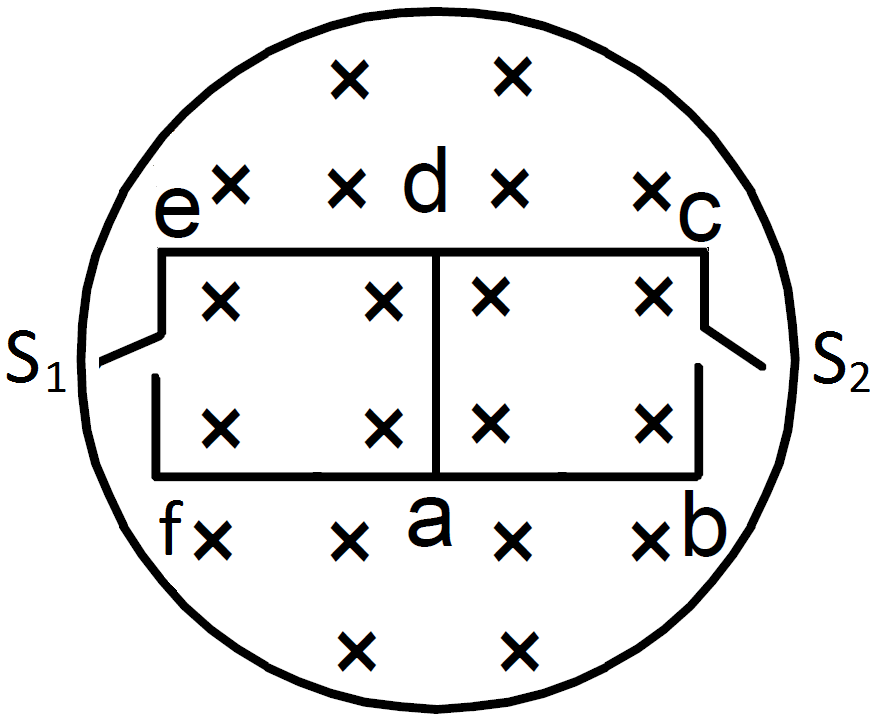
The magnetic field in the cylindrical region shown in figure increases at a constant rate of $20.0mT/s$. Each side of the square loop abcd and defa has a length of $1.00cm$ and a resistance of $4.00\Omega.$ Find the current (magnitude and sense) in the wire ad if:
  1. The switch $S_1$ is closed but $S_2$ is open.
  2. $S_1$ is open but $S_2$ ia closed.
  3. Both $S_1$ and $S_2$ are open.
  4. Both $S_1$ and $S_2$ are closed.
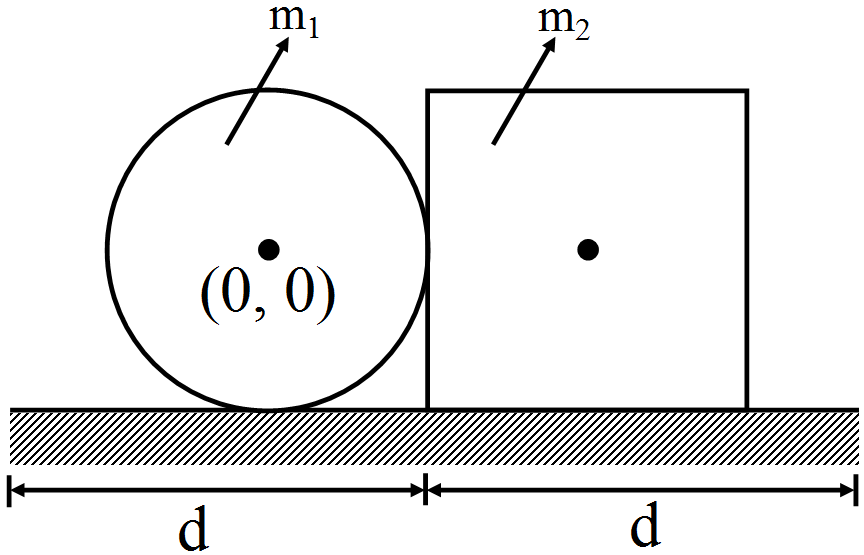
A square plate of edge d and a circular disc of diameter d are placed touching each other at the midpoint of an edge of the plate as shown in figure. Locate the centre of mass of the combination, assuming same mass per unit area for the two plates.
Define moment of inertia of a body. Give its units and dimensions. What is the physical significance of moment of inertia?
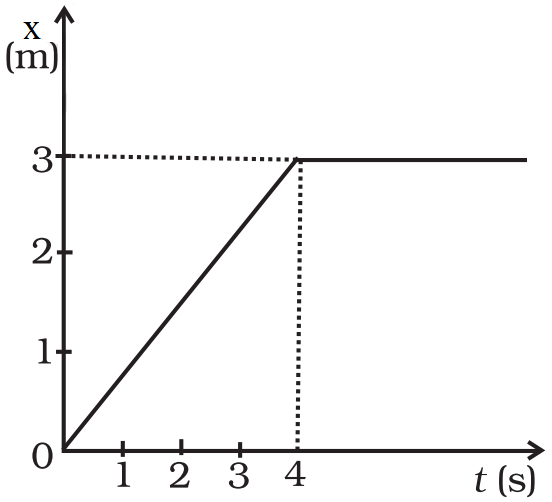
The position time graph of a body of mass $2kg$ is as given in What is the impulse on the body at $t = 0 s$ and $t = 4s$.
A ball is dropped from a building of height $45m$. Simultaneously another ball is thrown up with a speed $40m/s$. Calculate the relative speed of the balls as a function of time.
Consider the situation of the previous problem.
  1. Calculate the force needed to keep the sliding wire moving with a constant velocity $v$.
  2. If the force needed just after $t = 0$ is $F_0$, find the time at which the force needed will be $\frac{\text{F}_0}{2}.$
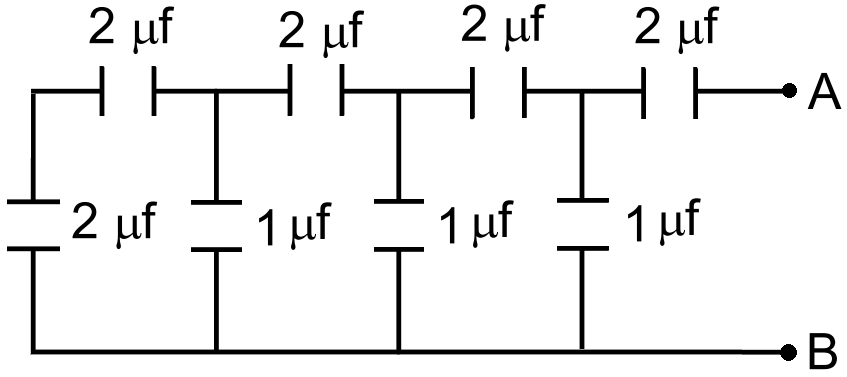
Find the capacitance of the combination shown in figure between A and B.
The electric field associated with a light wave is given by $\text{E}=\text{E}_0\sin[(1.57\times10^7\text{m}^{-1})(\text{x}-{\text{ct}})].$ Find the stopping potential when this light is used in an experiment on photoelectric effect with the emitter having work function 1.9eV.