Question
One end of a long string of linear mass density $8.0 \times 10^{–3}kg m^{–1}$ is connected to an electrically driven tuning fork of frequency $256Hz$. The other end passes over a pulley and is tied to a pan containing a mass of $90kg$. The pulley end absorbs all the incoming energy so that reflected waves at this end have negligible amplitude. At $t = 0$, the left end (fork end) of the string $x = 0$ has zero transverse displacement $(y = 0)$ and is moving along positive y-direction. The amplitude of the wave is $5.0cm$. Write down the transverse displacement y as function of x and t that describes the wave on the string.
Answer

The equation of a travelling wave propagating along the positive y-direction is given by the displacement equation: $\text{y}(\text{x, t})=\text{a}\sin(\text{wt}-\text{kx})\ \dots(\text{i})$ Linear mass density, $\mu=8.0\times10^{-3}\text{kg m}^{-1}$ Frequency of the tuning fork, ν = 256Hz Amplitude of the wave, a = 5.0cm = 0.05m …(ii) Mass of the pan, m = 90kg Tension in the string, $T = mg = 90 \times 9.8 = 882N$ The velocity of the transverse wave v, is given by the relation: $\text{v}=\sqrt{\frac{\text{t}}{\mu}}$
$=\frac{882}{8.0\times10^{-3}}=332\text{m/s}$ Angular Frequency, $\omega=2\pi\text{v}$
$=2\times3.14\times256$
$=1608.5=1.6\times10^3\text{ rad/s}\ \dots(\text{iii})$ Wanelength, $\lambda=\frac{\text{v}}{\text{v}}=\frac{332}{256}\text{m}$
$\therefore$ Propagation constant, $\text{k}=\frac{2\pi}{\lambda}$
$=\frac{2\times3.14}{\frac{332}{256}}=4.84\text{m}^{-1}\ \dots(\text{iv})$Substituting the values from equations (ii), (iii) and (iv) in equatio (i) we get the displacement equation:
$\text{y}(\text{x, t})=0.05\sin(1.6\times10^3\text{t}-4.84\text{x})\text{m}.$

Need a full question paper?

Generate a complete, print-ready paper with questions like this in minutes — across 16+ boards, with answer keys.

Start Generating Free

Similar questions

Two bodies of masses $m_1$ and $m_2$ and specific heat capacities $s_1$ and $s_2$ are connected by a rod of length I , crosssectional area A , thermal conductivity K and negligible heat capacity. The whole system is thermally insulated. At time $t=0$, the temperature of the first body is $T_1$ and the temperature of the second body is $T_2\left(T_2>T_1\right)$. Find the temperature difference between the two bodies at time $t$.
A gas undergoes reduction in volume (i) adiabatically, (ii) isothermally. Find the work done in the process.
What are methods of reducing friction? Write these and explain. Or Explain what are the measures to reduce the effect of friction. Explain the usefulness of lurbicants
A ball is thrown vertically upwards with a velocity of $20 m s ^{-1}$ from the top of a multistorey building. The height of the point from where the ball is thrown is $25.0 m$ from the ground. (a) How high will the ball rlse? and (b) how long will it be before the ball hits the ground? Take $g =10 m s ^{-2}$.
Mercury has an angle of contact equal to $140^{\circ}$ with soda lime glass. A narrow tube of radius $1.00$ mm made of this glass is dipped in a trough containing mercury. By what amount does the mercury dip down in the tube relative to the liquid surface outside? Surface tension of mercury at the temperature of the experiment is $0.465 \mathrm{~N} \mathrm{~m}^{-1}$. Density of mercury $=13.6 \times 10^3 \mathrm{~kg} \mathrm{~m}^{-3}$.
A helicopter of mass $1000kg$ rises with a vertical acceleration of $15ms^{-2}$​​​​​​​. The crew and the passengers weigh $300kg$. Give the magnitude and direction of the,
  1. Force on the floor by the crew and passengers.
  2. Action of the rotor of the helicopter on the surrounding air.
  3. Force on the helicopter due to the surrounding air.
Two bodies with masses $10kg$ and $12kg$ are connected by a light inextensible string passing over a smooth fixed pulley. Find:
  1. the velocity at the end of 3s,
  2. the distance covered in 3s,
  3. if, at the end of 3 s the string is cut, find the distance moved by the bodies in the next 6s.
An adiabatic vessel of total volume V is divided into two equal parts by a conducting separator. The separator is fixed in this position. The part on the left contains one mole of an ideal gas (U = 1.5nRT) and the part on the right contains two moles of the same gas. Initially, the pressure on each side is p. The system is left for sufficient time so that a steady state is reached. Find,
  1. The work done by the gas in the left part during the process.
  2. The temperature on the two sides in the beginning.
  3. The final common temperature reached by the gases.
  4. The heat given to the gas in the right part.
  5. The increase in the internal energy of the gas in the left part.
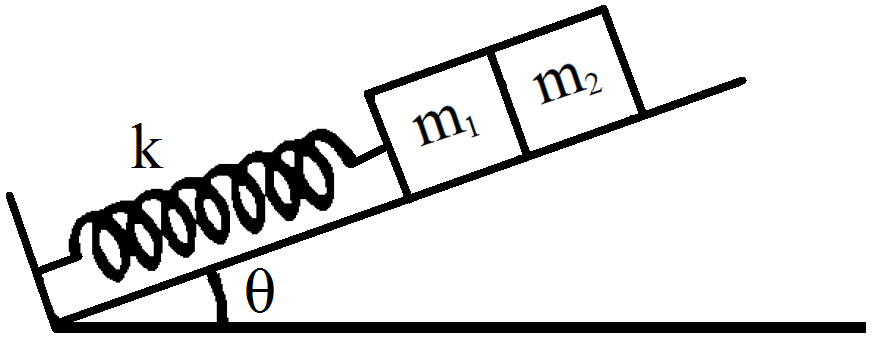
The block of mass $m_1$ shown in figure is fastened to the spring and the block of mass $m_2$ is placed against it.
  1. Find the compression of the spring in the equilibrium position.
  2. The blocks are pushed a further distance $\big(\frac{2}{\text{k}}\big)(\text{m}_1+\text{m}_2)\text{g}\sin\theta$ sine against the spring and released. Find the position where the two blocks separate.
  3. What is the common speed of blocks at the time of separation?
The length of a sonometer wire between two fixed ends is $110cm$. Where should the two bridges be placed so as to divide the wire into three segments, whose fundamental frequencies are in the ratio $1 : 2 : 3$?