MCQ
One end of a metal rod is kept in a furnace. In steady state, the temperature of the rod:
  • A
    Increases.
  • B
    Decreases.
  • C
    Remains constant.
  • Is nonuniform.

Answer

Correct option: D.
Is nonuniform.
In steady state, the temperature of the rod is nonuniform maximum at the end near the furnace and minimum at the end that is away from the furnace.

Need a full question paper?

Generate a complete, print-ready paper with questions like this in minutes — across 16+ boards, with answer keys.
Start Generating Free

Similar questions

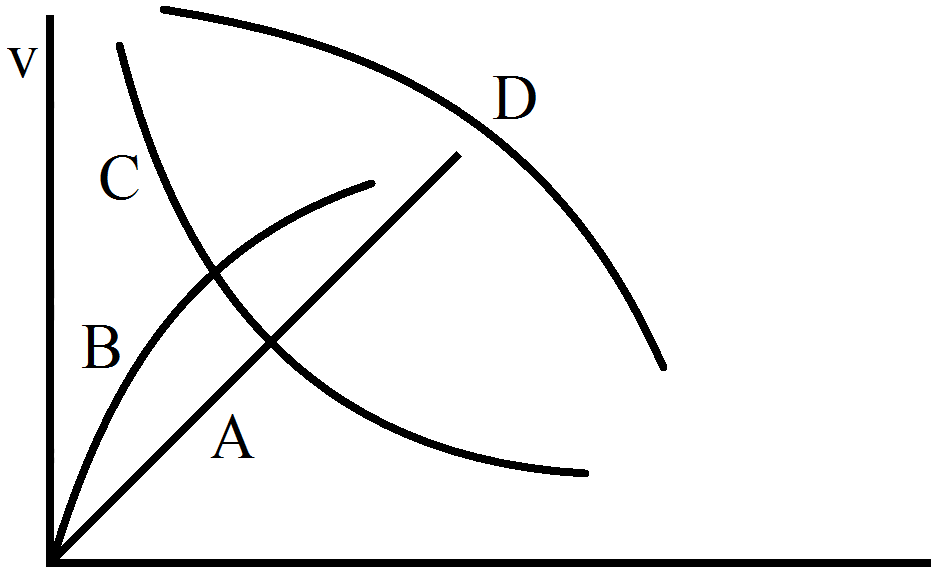
A spherical ball is dropped in a long column of a viscous liquid. The speed of the ball as a function of time may be best represented by the graph:
An inverted tube barometer is kept on a lift  with a moving downward with a deceleration $\alpha $ . The density of mercury is $\rho$ and acceleration due to gravity is $g$ . If the atmospheric pressure be $P_0$ then
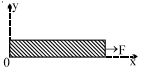
A uniform rod of length $L$ and mass $M$ has been placed on a rough horizontal surface. The horizontal force $F$ applied on the rod is such that the rod is just in the state of rest. If the coefficient of friction varies according to the relation $\mu = Kx$ where $K$ is a $+$ ve constant. Then the tension at mid point of rod is
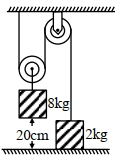
The boxes of masses $2\, {kg}$ and $8\, {kg}$ are connected by a massless string passing over smooth pulleys. Calculate the time taken by box of mass $8\; {kg}$ to strike the ground starting from rest. (use $\left.{g}=10\, {m} / {s}^{2}\right)$ (in ${s}$)
A Tennis ball is released from a height $h$ and after freely falling on a wooden floor it rebounds and reaches height $\frac{ h }{2} .$ The velocity versus height of the ball during its motion may be represented graphically by 

(graph are drawn schematically and on not to scale)
A particle of mass $1g$ moving with a velocity $\text{v}_1=3\hat{\text{i}}-2\hat{\text{j}}\text{ms}^{-1}$ experiences a perfectly elastic collision with another particle of mass $2g$ and velocity $\text{v}_2=4\hat{\text{j}}-6\hat{\text{k}}\text{ms}^{-1}$. The velocity of the particle is:
A force of $5 \,N$ acts on a body of weight $9.8 \,N$. What is the acceleration produced in $m/{\sec ^2}$
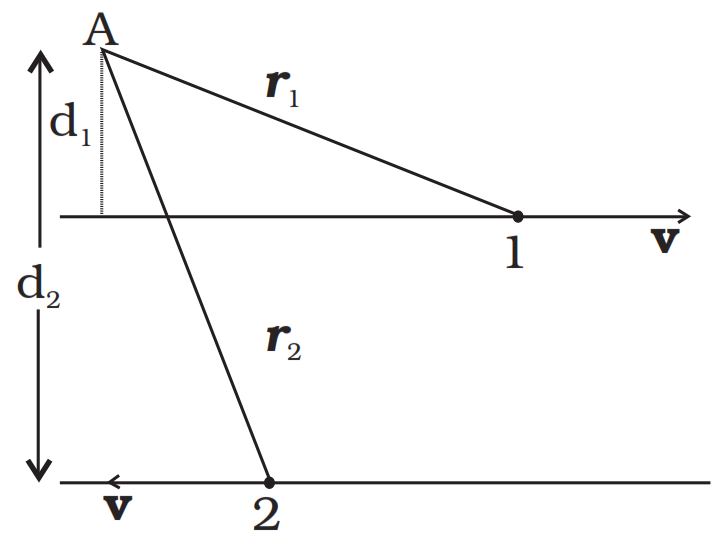
Shows two identical particles $1$ and $2$, each of mass $m,$ moving in opposite directions with same speed $v$ along parallel lines. At a particular instant, $r_1$ and $r_2$ are their respective position vectors drawn from point A which is in the plane of the parallel lines . Choose the correct options:
  1. Angular momentum $I_1$ of particle $1$ about $A$ is $I = mvd_1$
  2. Angular momentum $I_2$ of particle $2$ about $A$ is $I_2= mvr_2$
  3. Total angular momentum of the system about $A$ is $\text{I}=\text{mv}(\text{r}_1+\text{r}_2)$
  4. Total angular momentum of the system about $A$ is $\text{I}=\text{mv}(\text{d}_2-\text{d}_1)\otimes$ represents a unit vector coming out of the page. $\otimes$ represents a unit vector going into the page.
The density of a cube is measured by measuring its mass and the length of its sides. If the maximum error in the measurement of mass and length are $3\%$ and $2\%$ respectively, then find the maximum error in the measurement of the density of cube.......... $\%$
A satellite is revolving round the earth with orbital speed $v_0$. If it stops suddenly, the speed with which it will strike the surface of earth would be : ($v_e =$ escape velocity of a particle on earth's surface)