MCQ
One kilowatt hour is equal to
  • $36 \times {10^5}\;J$
  • B
    $36\times{10^3}\;J$
  • C
    $36 \times 10^{-5}\;J$
  • D
    $36 \times 10^{-4}\;J$

Answer

Correct option: A.
$36 \times {10^5}\;J$
a
$1\, kWh = 1000\, W \times 3600 \,sec = 36 \times 10^5\,W-sec\,\, ($ or $J)$

Need a full question paper?

Generate a complete, print-ready paper with questions like this in minutes — across 16+ boards, with answer keys.

Start Generating Free

Similar questions

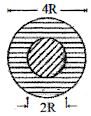
A wire of circular cross section has inner portion of radius $R$ made of material of resisitivity $\rho$ and is surrounded by an outer portion of thickness $R$ made of a material of double resisitivity. Find the resistance of length $l$ of such wire
A resonant $ ac $ circuit contains a capacitor of capacitance ${10^{ - 6}}F$ and an inductor of ${10^{ - 4}}H.$ The frequency of electrical oscillations will be
Two tuning forks $A$ and $B$ give $4$ beats per second. The frequency of $A$ is $256 Hz$. On loading $B$ slightly, we get $5$ beats in $2$ seconds. The frequency of $B$ after loading is .... $Hz$
Given below are two statements. One is labelled as Assertion (A) and the other is labelled as Reason (R).
Assertion (A) : The binding energy per nucleon is found to be practically independent of the atomic number A , for nuclei with mass numbers between 30 and 170.
Reason (R): Nuclear force is long range.
In the light of the above statements, choose the correct answer from the options given below :
A car travels half the distance with constant velocity of $40\, kmph$ and the remaining half with a constant velocity of $60 \,kmph$. The average velocity of the car in $kmph$ is
A car $'A'$ chasing another car $'B'$ with a speed of $20\, m/s$ sounding a horn of $180\, Hz$. While both cars are moving towards a stationary siren of frequency $170\, Hz$. What is the speed of car $B$ so that it can't hear any beat ....$m/s$ (speed of sound $= 340\, m/s$)
An object viewed from a near point distance of $25\, {cm}$, using a microscopic lens with magnification $'6',$ gives an unresolved image. A resolved image is observed at infinite distance with a total magnification double the earlier using an eyepiece along with the given lens and a tube of length $0.6\, {m}$, if the focal length of the eyepiece is euqal to $.... \,{cm} .$
A wooden cylinder floats vertically in water with half of its length immersed. The density of wood is
The $S.I.$ unit of electric flux is
Gravitational potential at the centre of curvature of a hemispherical bowl of radius $R$ and mass $M$ is $V.$