MCQ
One mole of helium is adiabatically expanded from its initial state $({P_i},{V_i},{T_i})$ to its final state $({P_f},{V_f},{T_f})$. The decrease in the internal energy associated with this expansion is equal to
  • ${C_V}({T_i} - {T_f})$
  • B
    ${C_P}({T_i} - {T_f})$
  • C
    $\frac{1}{2}({C_P} + {C_V})(Ti - {T_f})$
  • D
    $({C_P} - {C_V})({T_i} - {T_f})$

Answer

Correct option: A.
${C_V}({T_i} - {T_f})$
a
(a)$\Delta U = \mu {C_V}\Delta T = 1 \times {C_V}({T_f} - {T_i}) = - \,{C_V}({T_i} - {T_f})$
==> |$\Delta U$| $= C_V (T_i -T_f)$

Need a full question paper?

Generate a complete, print-ready paper with questions like this in minutes — across 16+ boards, with answer keys.

Start Generating Free

Similar questions

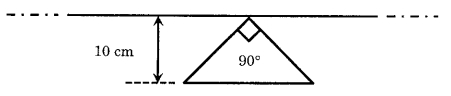
A conducting loop in the shape of a right angled isosceles triangle of height $10 \mathrm{~cm}$ is kept such that the $90^{\circ}$ vertex is very close to an infinitely long conducting wire (see the figure). The wire is electrically insulated from the loop. The hypotenuse of the triangle is parallel to the wire. The current in the triangular loop is in counterclockwise direction and increased at a constant rate of $10 \mathrm{As}^{-1}$. Which of the following statement($s$) is(are) true?

($A$) The magnitude of induced emf in the wire is $\left(\frac{\mu_0}{\pi}\right)$ volt

($B$) If the loop is rotated at a constant angular speed about the wire, an additional emf of $\left(\frac{\mu_0}{\pi}\right)$ volt is induced in the wire

($C$) The induced current in the wire is in opposite direction to the current along the hypotenuse

($D$) There is a repulsive force between the wire and the loop

A simple pendulum has time period 't'. Its time period in a lift which is moving upwards with acceleration $3 ms ^{-2}$ is
Two particles of charges $+Q$ and $-Q$ are projected from the same point with a velocity $v$ in a region of uniform magnetic field $B$ such that the velocity vector makes an angle $q$ with the magnetic field. Their masses are $M$ and $2M,$ respectively. Then, they will meet again for the first time at a point whose distance from the point of projection is
The value of $C_V$ for one mole of neon gas is
A body of mass $‘m’$ is dropped from a height of $‘h’$. Simultaneously another body of mass $2m$ is thrown up vertically with such a velocity $v$ that they collide at the height $h/2$. If the collision is perfectly inelastic, the velocity at the time of collision with the ground will be :
The decay constant for a radioactive nuclide is $1.5 \times 10^{-5} s ^{-1}$. Atomic of the substance is $60\,g$ mole $^{-1},\left( N _{ A }=6 \times 10^{23}\right)$. The activity of $1.0\,\mu g$ of the substance is $.......\,\times 10^{10}\,Bq$
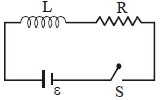
A shown in the figure, a battery of $emf \;\varepsilon$ is connected to an inductor $L$ and resistance $R$ in series. The switch is closed at $t=0 .$ The total charge that flows from the battery, between $\mathrm{t}=0$ and $\mathrm{t}=\mathrm{t}_{\mathrm{c}}\;( \mathrm{t}_{\mathrm{c}}$ is the time constant of the circuit) is
A $100\, ohm$ galvanometer gives full scale deflection at $10\, mA$. How much shunt is required to read $100\, mA$ .............. $ohm$
The wavelength is $120 cm$ when the source is stationary. If the source is moving with relative velocity of $60\, m/sec$ towards the observer, then the wavelength of the sound wave reaching to the observer will be ... $cm$ (velocity of sound $= 330 \,m/s$)
At any instant, two elements $X _1$ and $X _2$ have same number of radioactive atoms. If the decay constant of $X _1$ and $X _2$ are $10 \lambda$ and $\lambda$ respectively. then the time when the ratio of their atoms becomes $\frac{1}{e}$ respectively will be