Question
One of the forms of a naturally occurring solid compound $P$ is usually used for making the floors of houses. On adding a few drops of dilute hydrochloric acid to $P$, brisk effervescence are produced. When $50\ g$ of reactant $P$ was heated strongly, than $22\ g$ of a gas $Q $and $28\ g$ of a solid $R$ were produced as products. Gas $Q$ is the same which produced brisk effervescence on adding dilute HCl to $P$. Gas $Q$ is said to cause global warming whereas solid $R$ is used for white-washing.
a. What is (i) solid $P$ (ii) gas $Q$, and (iii) solid $R$.
b. What is the total mass of $Q$ and $R$ obtained from $50\ g$ of $P$ ?
c. How does the total mass of $Q$ and $R$ formed compare with the mass of $P$ taken?
d. What conclusion do you get from the comparison of masses of products and reactant?
e. Which law of chemical combination is illustrated by the example given in this problem?
Answer

$\text{P(solid)}\xrightarrow{ \ \ \ \ \ \ \ \ \ \ \ \ }\text{Q(gas)}+\text{R(solid)}\\ \ \ ^{50\text{gm}}\ \ \ \ \ \ \ \ \ \ \ \ \ \ \ \ \ \ \ \ ^{22\text{gm}}\ \ \ \ \ \ \ \ \ \ ^{28\text{gm}}$
Solid $P$: Calcium Carbonate $(CaCO_3)$
Gas $Q$: Carbon dioxide $(CO_2)$
Solid $R$: Calcium oxide $(CaO)$​​​​​​​​​​​​​​
  1. Total mass of $Q$ and $R = 22gm + 28gm = 50gm$
  2. Total mass of $Q$ and $R (50\ gm)$ is equal to mass of reactant $(50\ gm)$.
  3. The law of conservation of mass is followed, i.e. total mass of product is equal to mass of reactant.
  4. Law of conservation of mass is illustrated by the example.

Need a full question paper?

Generate a complete, print-ready paper with questions like this in minutes — across 16+ boards, with answer keys.

Start Generating Free

Similar questions

Discuss the method of separating a mixture containing chalk powder, iron fillings and naphthalene.
Give the formulate of the compounds formed from the following sets of elements:
  1. Calcium and fluorine.
  2. Hydrogen and sulphur.
  3. Nitrogen and hydrogen.
  4. Carbon and chlorine.
  5. Sodium and oxygen.
  6. Carbon and oxygen.
Suppose a planet exists whose mass and radius both are half those of the earth. Calculate the acceleration due to gravity on the surface of this planet.
A stone is dropped from a height of $20\ m.$
How long will it take to reach the ground?
A ball $X$ of mass 1 kg travelling at $2 m / s$ has a head-on collision with an identical ball $Y$ at rest. $X$ stops and $Y$ moves off. Calculate the velocity of $Y$ after the collision.
The mass of one molecule of a substance is $4.65 \times 10^{-23} g$. What is its molecular mass? What could this substance be?
State and explain Newton’s second law of motion.
How will you separate a mixture of iron filings, chalk powder an common salt?
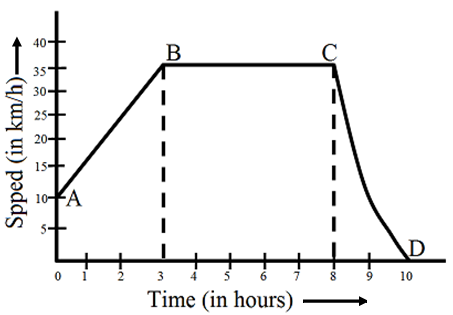
The graph given alongside shows how the speed of a car changes with time:
  1. What is the initial speed of the car?
  2. What is the maximum speed attained by the car?
  3. Which part of the graph shows zero acceleration
  4. Which part of the graph shows varying retardation?
  5. Find the distance travelled in first 8 hours.
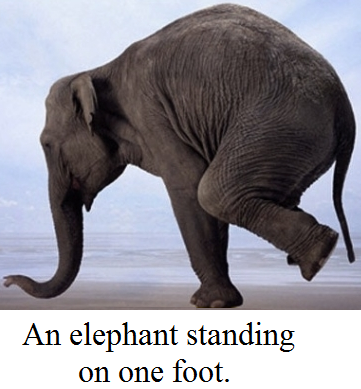
An elephant weighing $40,000\ N$ stands on one foot of area $1000\ cm^2$ whereas a girl weighing $400\ N$ is standing on one ‘stiletto’ heel of area $1cm^2.$​​​​​​​

  1. Which of the two, elephant or girl, exerts a larger force on the ground and by how much?
  2. What pressure is exerted on the ground by the elephant standing on one foot?
  3. What pressure is exerted on the ground by the girl standing on one heel?
  4. Which of the two exerts larger pressure on the ground: elephant or girl?
  5. What is the ratio of pressure exerted by the girl to the pressure exerted by the elephant?