One of the two identical conducing wires of length $L$ is bent in the form of a circular loop and the other one into a circular coil of $N$ identical turns. If the same current is passed in both, the ratio of the magnetic field at the central of the loop $(B_L)$ to that at the centre of the coil $(B_C),$; $.\,\frac {B_L}{B_C}$ will be
JEE MAIN 2019, Medium
Download our app for free and get started
$B_{L}=\frac{\mu_{0} i}{2 R}$
$B_{C}=\frac{\mu_{0} N i}{2(R / N)}$
$\therefore \quad \frac{B_{L}}{B_{C}}=\frac{1}{N^{2}}$

Download our appand get started for free
Experience the future of education. Simply download our apps or reach out to us for more information. Let's shape the future of learning together!No signup needed.*
Similar Questions
- 1An ammeter whose resistance is $180\,\Omega $ gives full scale deflection when current is $2\, mA$. The shunt required to convert it into an ammeter reading $20\, mA$ (in $ohms$) isView Solution
- 2An electron is moving on a circular path of radius $r$ with speed $v$ in a transverse magnetic field $B$. $e/m$ for it will beView Solution
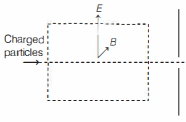
- 3View SolutionA stream of charged particles enter into a region with crossed electric and magnetic fields as shown in the figure below. On the other side is a screen with a hole that is right on the original path of the particles. Then,
- 4If two protons are moving with speed $v=4.5 \times 10^{5} \,m / s$ parallel to each other then the ratio of electrostatic and magnetic force between themView Solution
- 5When a charged particle moving with velocity $\vec V$ is subjected to a magnetic field of induction $\vec B$ , the force on it is non-zero. This implies theView Solution
- 6An electron is moving on a circular path of radius $r$ with speed $v$ in a transverse magnetic field $B$. $e/m$ for it will beView Solution
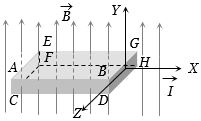
- 7A metallic block carrying current $I$ is subjected to a uniform magnetic induction $\overrightarrow B $ as shown in the figure. The moving charges experience a force $\overrightarrow F $ given by ........... which results in the lowering of the potential of the face ........ Assume the speed of the carriers to be $v$View Solution
- 8A coil of $50\, turns$ and $4\,cm$ radius carries $2\,A$ current then magnetic field at its centre is......$mT$View Solution
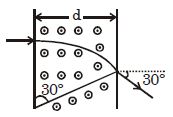
- 9A particle of charge $q$, mass $m$ enters in a region of magnetic field $B$ with velocity $V_0 \widehat i$. Find the value of $d$ if the particle emerges from the region of magnetic field at an angle $30^o$ to its ititial velocity:-View Solution
- 10An $\alpha$-particle (mass $4 amu$ ) and a singly charged sulfur ion (mass $32 amu$ ) are initially at rest. They are accelerated through a potential $V$ and then allowed to pass into a region of uniform magnetic field which is normal to the velocities of the particles. Within this region, the $\alpha$-particle and the sulfur ion move in circular orbits of radii $r_\alpha$ and $r_5$, respectively. The ratio $\left(r_s / r_\alpha\right)$ is. . . . .$(4)$View Solution