Question
One Tesla is equal to
|
(a) |
(b) |
(c) |
(d) |
One Tesla is equal to
|
(a) |
(b) |
(c) |
(d) |
(c) 
Generate a complete, print-ready paper with questions like this in minutes — across 16+ boards, with answer keys.
The resultant magnetic moment of neon atom will be
|
(a) Infinity |
(b) mB |
(c) Zero |
(d) mB/2 |
$1:1$
$1:2$
$\pi:2$
$2:\pi$
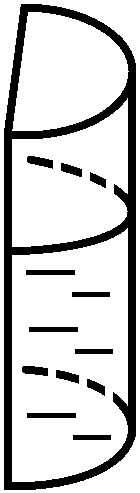
A parallel plate air capacitor has a capacitance of 100 μμF. The plates are at a distance d apart. If a slab of thickness t( t ≤ d) and dielectric constant 5 is introduced between the parallel plates, then the capacitance will be
|
(a) 50 μμF |
(b) 100 μμF |
(c) 200 μμF |
(d) 500 μμF |
The mutual inductance between two coils is 1.25 henry. If the current in the primary changes at the rate of 80 ampere/second, then the induced e.m.f. in the secondary is
|
(a) 12.5 V |
(b) 64.0 V |
(c) 0.016 V |
(d) 100.0 V |
The cathode of a photoelectric cell is changed such that the work function changes from W1 to W2 (W2>W1). If the current before and after change are I1 and I2, all other conditions remaining unchanged, then (assuming hn > W2)
|
(a) |
(b) |
(c) |
(d) |
A current of 1.5 A flows through a copper voltameter. The thickness of copper deposited on the electrode surface of area  in 20 minutes will be (Density of copper = 9000
  and E.C.E. of copper = 0.00033 g/C)
|
(a) 2.6 |
(b) 2.6 |
(c) 1.3 |
(d) 1.3 |
Faraday's laws are consequence of conservation of
|
(a) Energy |
(b) Energy and magnetic field |
|
(c) Charge |
(d) Magnetic field |
Due to 10 ampere of current flowing in a circular coil of 10 cm radius, the magnetic field produced at its centre is 3.34  . The number of turns in the coil will be
|
(a) 5000 |
(b) 100 |
(c) 50 |
(d) 25 |
In the following transitions, which one has higher frequency
|
(a) 3 – 2 |
(b) 4 – 3 |
(c) 4 – 2 |
(d) 3 – 1 |


