MCQ
One watt is equal to __________?
- AOne kilowatt per second.
- BOne kilo joule per second.
- COne joule per second.
- DOne joule per minute.
Explanation:
Watt is the SI unit of power.
$\text{Power}=\frac{\text{Work done}}{\text{time}}$.
The SI unit of work done is the same as energy, that is, joule and that of time is seconds. Therefore, one watt is equal to one joule per second.
Generate a complete, print-ready paper with questions like this in minutes — across 16+ boards, with answer keys.
Force of attraction between the plates of a parallel plate capacitor is
|
(a) |
(b) |
(c) |
(d) |
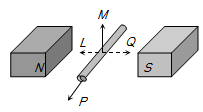
An electric potential difference will be induced between the ends of the conductor shown in the diagram, when the conductor moves in the direction
|
(a) P |
(b) Q |
(c) L |
(d) M |
A solid reflects incident light and it’s electrical conductivity decreases with temperature. The binding in this solids
|
(a) Ionic |
(b) Covalent |
(c) Metallic |
(d) Molecular |
If  undergoes successively 8 a-decays and 6 b-decays, then resulting nucleus is
|
(a) |
(b) |
(c) |
(d) |
Assertion : Coloured spectrum is seen when we look through a muslin cloth.
Reason : It is due to the diffraction of white light on passing through fine slits.
|
(a) If both assertion and reason are true and the reason is the correct explanation of the assertion. |
|
(b) If both assertion and reason are true but reason is not the correct explanation of the assertion. |
|
(c) If assertion is true but reason is false. |
|
(d) If the assertion and reason both are false. |
Which of the following atoms has the lowest ionization potential
|
(a) |
(b) |
(c) |
(d) |


