Maharashtra BoardEnglish MediumSTD 12 ScienceChemistryHalogen Derivatives4 Marks
Question
Optical isomerism in $2$-chlorobutane. Explain
✓
Answer
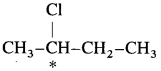
(1) $2$-Chlorobutane contains an asymmetric.
carbon atom (the starred carbon atom) which is attached to four different groups, i.e., ethyl $(-CH_2 – CH_3)$, methyl $(CH_3)$, chloro $(Cl)$ and hydrogen (H) groups.
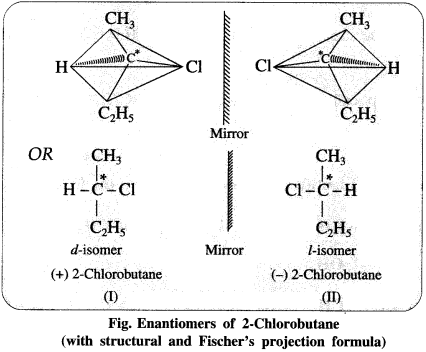
(2) Two different arrangements of these groups around the carbon atom are possible as shown in the figure. Hence, it exists as a pair of enanti¬omers. The two enantiomers are mirror images of each other and are not superimposable.
(3) One of the enantiomers will rotate the plane of plane-polarized light to the left hand side and is called the laevorotatory isomer (/-isomer). The other enantiomer will rotate the plane of plane-polarized light to the right hand side and is called the dextrorotatory isomer (d-isomer).
(4) Equimolar mixture of the d- and the 1-isomers is optically inactive and is called the racemic mixture or the racemate (dl-mixture). The optical inactivity of the racemic mixture is due to external compensation.
Need a full question paper?
Generate a complete, print-ready paper with questions like this in minutes — across 16+ boards, with answer keys.