MCQ
Optically active isomers but not mirror images are called
  • A
    Enantiomers
  • B
    Mesomers
  • C
    Tautomers
  • Diastereoisomers

Answer

Correct option: D.
Diastereoisomers
d
(d) Diastereoisomers -Optical isomers which are not mirror images of each other.
e.g.

$\mathop {\mathop {H - \mathop C\limits_|^| - OH}\limits_{H - \mathop C\limits_| - OH}^{\;\;\;\;\;COOH} }\limits_{\;\;\;\;COOH} $ and $\mathop {\mathop {H - \mathop C\limits_|^| - OH}\limits_{HO - \mathop C\limits_| - H\;\;\;\,}^{\;\;\;\;\;COOH} }\limits_{\;\;\;\;COOH} $
 

Need a full question paper?

Generate a complete, print-ready paper with questions like this in minutes — across 16+ boards, with answer keys.

Start Generating Free

Similar questions

A solution of $Ni(NO_3)_2$ is electrolysed between platinum electrodes using $0.1$ Faraday electricity. How many mole of $Ni$ will be deposited at the cathode?
Which of the following is not true for transition metals
The reaction of $K _3\left[ Fe ( CN )_6\right]$ with freshly prepared $FeSO _4$ solution produces a dark blue precipitate called Turnbull's blue. Reaction of $K _4\left[ Fe ( CN )_6\right]$ with the $FeSO _4$ solution in complete absence of air produces a white precipitate $X$, which turns blue in air. Mixing the $FeSO _4$ solution with $NaNO _3$, followed by a slow addition of concentrated $H _2 SO _4$ through the side of the test tube produces a brown ring.

Precipitate $X$ is

$(A)$ $Fe _4\left[ Fe ( CN )_6\right]_3$

$(B)$ $Fe \left[ Fe ( CN )_6\right]$

$(C)$ $K _2 Fe \left[ Fe ( CN )_6\right]$

$(D)$ $KFe \left[ Fe ( CN )_6\right]$

Among the following, the brown ring is due to the formation of

$(A)$ $\left[ Fe ( NO )_2\left( SO _4\right)_2\right]^{2-}$

$(B)$ $\left[ Fe ( NO )_2\left( H _2 O \right)_4\right]^{3+}$

$(C)$ $\left[ Fe ( NO )_4\left( SO _4\right)_2\right]$

$(D)$ $\left[ Fe ( NO )\left( H _2 O \right)_5\right]^{2+}$
The energy of an electron in the ground state $(n=1)$ for $\mathrm{He}^{+}$ion is $-x ~J$, then that for an electron in $n=2$ state for $Be^{3+}$ ion in $J$ is
Give below are two statements: 
Statement-I : Noble gases have very high boiling points.
Statement-II: Noble gases are monoatomic gases. They are held together by strong dispersion forces. Because of this they are liquefied at very low temperature. Hence, they have very high boiling points. 
In the light of the above statements. choose the correct answer from the options given below:
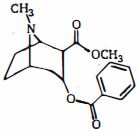
The structural formula of cocaine is shown below. How many stereogenic carbon  atoms are there in this molecule ?
In graphite and diamond, the percentage of $p-$ characters of the hybrid orbitals in hybridisation are respectively
Given below are two statements: one is labelled as Assertion $A$ and the other is labelled as Reason $R$.

Assertion $A$ : Boric acid is a weak acid

Reason $R$ : Boric acid is not able to release $H ^{+}$ion on its own. It receives $OH ^{-}$ion from water and releases $H ^{+}$ion.

In the light of the above statements, choose the most appropriate answer from the options given below.

Ratio of ${C_p}$ and ${C_v}$ of a gas $X$ is $1.4$, the number of atom of the gas $‘X’$ present in $11.2$ litres of it at $NTP$ will be
The nucleus of tritium contains