MCQ
Orbital angular momentum for a $d-$ electron is
- A$\frac{{6h}}{{2\pi }}$
- ✓$\frac{{\sqrt 6 \,h}}{{2\pi }}$
- C$\frac{{12h}}{{2\pi }}$
- D$\frac{{\sqrt {12} \,h}}{{2\pi }}$
$\mu = \sqrt {l(l + 1)} \,\frac{h}{{2\pi }}$; $\mu = \sqrt {2\,(2 + 1)} \,\frac{h}{{2\pi }}$
$\mu = \sqrt {2\,(2 + 1)} \frac{h}{{2\pi }}$; $\mu = \,\sqrt 6 \frac{h}{{2\pi }}.$
Generate a complete, print-ready paper with questions like this in minutes — across 16+ boards, with answer keys.
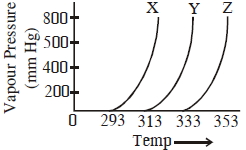
The following inferences are made
$(A)$ $\mathrm{X}$ has higher intermolecular interactions compared to $Y$.
$(B)$ $\mathrm{X}$ has lower intermolecular interactions compared to $Y$.
$(C)$ $\mathrm{Z}$ has lower intermolecular interactions compared to $Y.$
The correct inference(s) is/are