MCQ
Orbital velocity of an artificial satellite does not depend upon
  • A
    Mass of the earth
  • Mass of the satellite
  • C
    Radius of the earth
  • D
    Acceleration due to gravity

Answer

Correct option: B.
Mass of the satellite
b
(b)$v = \sqrt {\frac{{GM}}{r}} $

Need a full question paper?

Generate a complete, print-ready paper with questions like this in minutes — across 16+ boards, with answer keys.
Start Generating Free

Similar questions

Work done in raising a box depends on
A ball moving with velocity $2 \,m/s$ collides head on with another stationary ball of double the mass. If the coefficient of restitution is $0.5,$ then their velocities after collision will be
A particle moving in a circle of radius $R$ with a uniform speed takes a time $T$ to complete one revolution. If this particle were projected with the same speed at an angle ' $\theta$ ' to the horizontal, the maximum height attained by it equals $4 \mathrm{R}$. The angle of projection, $\theta$, is then given by
The inverse square law of intensity $\Big(\text{i.e., the intensity}\propto\frac{1}{\text{r}^2}\Big)$ is valid for a:
  1. Point source.
  2. Line source.
  3. Plane source.
  4. Cylindrical source.
A particle executes simple harmonic motion between x = -A and x = +A. The time taken for it to go from 0 to $\frac{\text{A}}{2}$ is T1 and to go from $\frac{\text{A}}{2}$ to A is T2 Then:
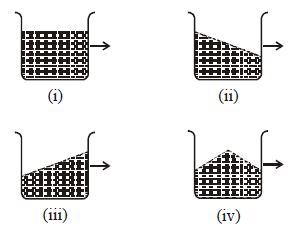
A vessel containing water is moving with a constant speed towards right along a straight horizontal path. if the vessel is given a constant retardation towards the right along a straight line, which of the above diagram represents the surface of the liquid?
Two simple harmonic motions are represented by the equations

${x}_{1}=5 \sin \left(2 \pi {t}+\frac{\pi}{4}\right)$ and ${x}_{2}=5 \sqrt{2}(\sin 2 \pi {t}+\cos 2 \pi {t})$

The amplitude of second motion is ....... times the amplitude in first motion.

The motor of an engine is rotating about its axis with an angular velocity of $100 rev / m$. It comes to rest in 15 s , after being switched off. Assuming constant angular deceleration, what are the number of revolutions made by it before coming to rest?
A body is revolving with a uniform speed $v$ in a circle of radius $r$. The tangential acceleration is
A closed pipe of length $10 \,cm$ has its fundamental frequency half that of the second overtone of an open pipe. The length of the open pipe ......... $cm$