MCQ
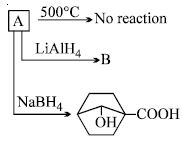
Organic compound $A$ does not undergo de carboxylation reaction because ?
  • A
    Intermediate does not follow Saytzeff'n rule
  • B
    Intermediate does not follow Hofmann's rule
  • Intermediate does not follow Bredict's rule
  • D
    Intermediate does not follow MarkwoniKoffs rule
Answer

Correct option: C.
Intermediate does not follow Bredict's rule
c
Bredt's rule is an empirical observation in organic chemistry that states that a double bond cannot be placed at the bridgehead of a bridged ring system.

Need a full question paper?

Generate a complete, print-ready paper with questions like this in minutes — across 16+ boards, with answer keys.

Start Generating Free

Similar questions

If the pressure in a reaction vessel for the following reaction is increased by decreasing the volume, what will happen to the concetrations of  $CO$  and $CO_2$ ?

${H_2}O(g){\mkern 1mu} {\mkern 1mu}  + {\mkern 1mu} CO{\mkern 1mu} (g){\mkern 1mu} {\mkern 1mu} {\mkern 1mu}  \rightleftharpoons \,{H_2}(g)\, + \,C{O_2}(g)\, + \,Heat{\mkern 1mu} {\mkern 1mu} {\mkern 1mu} {\mkern 1mu} $

Given Below are Two statement
How many secondary amine are possible with molecular formula $C_4H_{11}NH_2$
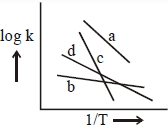
Consider the following plots of rate constant versus $\frac{1}{\mathrm{T}}$ for four different reactions. Which of the following orders is correct for the activation energies of these reactions?
Decarboxylation of all six possible forms of diaminobenzoic acids $C _{6} H _{3}\left( NH _{2}\right)_{2} COOH$ yields three products $A , B$ and $C$. Three acids give a product $'A',$ two acids gives a product $'B'$ and one acid give a product $'C'.$ The melting point of product $'C'$ is .....$^{\circ} C$.
Aqueous solutions of two compounds $M_1 - O - H$ and $M_2 - O - H $ are  prepared in two different beakers. If, the electronegativity of $M_1 = 3.4, M_2 =  1.2, O = 3.5$ and $H = 2.1,$ then the nature of two solutions will be respectively
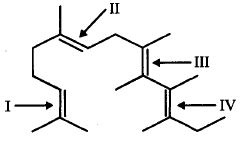
In the following structure, the double bonds are marked as $I, II, III$ and $IV$ Geometrical isomerism is not possible at site $(s)$
Chlorobenzene when condensed with chloral in the presence of conc. $H_2SO_4$ yields
The IUPAC name for the complex $\left[ Co \left( NH _3\right)_5\left( NO _2\right)\right] Cl _2$ is:
In the ration,

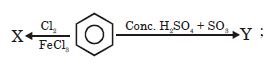
$X$ and $Y$ respectively are :-