MCQ
Organic compound $A$ does not undergo de carboxylation reaction because ?
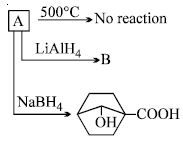
  • A
    Intermediate does not follow Saytzeff'n rule
  • B
    Intermediate does not follow Hofmann's rule
  • Intermediate does not follow Bredict's rule
  • D
    Intermediate does not follow MarkwoniKoffs rule

Answer

Correct option: C.
Intermediate does not follow Bredict's rule
c
Bredt's rule is an empirical observation in organic chemistry that states that a double bond cannot be placed at the bridgehead of a bridged ring system.

Need a full question paper?

Generate a complete, print-ready paper with questions like this in minutes — across 16+ boards, with answer keys.

Start Generating Free

Similar questions

The resistance of $0.5\, M$ solution of an electrolyte in a cell was found to be $50\,\Omega $. If the electrodes in the cell are $2.2\, cm$ apart and have an area of $4.4\, cm^2$ then the molar conductivity (in $S\, m^2\, mol^{-1}$) of the solution is
Biuret test is used for the detection of
The correct decreasing order of basic strength of the following species is $........ \mathrm{H}_2 \mathrm{O}, \mathrm{NH}_3, \mathrm{OH}^{-}, \mathrm{NH_2}^{-}$
The volume of water which must be added to $40\,cc$ of $0.25\,M$ oxalic acid solution to make it exactly decimolar $(0.1\,M)$ is ....... $cc$.
Identify final product in the following reaction

$\begin{matrix}
   C{{H}_{3}}CHCOOH\xrightarrow{\Delta }\,Product  \\
   |\,\,\,\,\,\,\,\,\,\,\,\,\,\,\,\,\,\,\,\,\,\,\,\,\,\,\,\,\,\,\,\,\,\,\,\,\,\,\,\,\,\,\,  \\
   OH\,\,\,\,\,\,\,\,\,\,\,\,\,\,\,\,\,\,\,\,\,\,\,\,\,\,\,\,\,\,\,\,\,\,\,\,\,\,\,  \\
\end{matrix}$

$CH_3-CH_2-CH_2-Br$ $\xrightarrow{{alk\,KOH}}A\xrightarrow[{(ii)\,{H_2}{O_2}/O{H^ - }}]{{(i)\,B{D_3}/HF}}B$  ;  $B$ is
Which of the following carbohydrate $(s)$ would not undergo mutarotation in  aqueous solution?
Aquaregia is $.....$ part conc$. \text{HCI}$ and $.....$ part conc$. \mathrm{HNO}_3$​.
Which of the following parameters is never affected by using a catalyst during a reaction?
For a given chemical reaction

$\gamma_{1} A +\gamma_{2} B \rightarrow \gamma_{3} C +\gamma_{4} D$

Concentration of $C$ changes from $10\, mmol$ appearance of $D$ is $1.5$ times the rate of disappearance of $B$ which is twice the rate of disappearance $A$. The rate of appearance of $D$ has been experimentally determined to be $9 \,m\,mol$ $dm ^{-3} s ^{-1}$. Therefore the rate of reaction is $......\,m\,mol\, dm ^{-3} \,s ^{-1}$. (Nearest Integer)