Question
Our resources cannot keep pace with the rising population. Give three examples in support of this statement.

Answer

(i) Food: The first and most important need of the humans (or any living organism) is food. But with the production of food rising by arithmetic progression and population growing by geometric progression i.e. the number at each step is being multiplied. At the same time growing population is increasing the use of more and more agricultural land to build houses. Thus it is evident that food would be running short for the unchecked rising population.
(ii) Water: Availability of clean and germ-free water for drinking purposes would be more and more scarce with increase in population; the reason would be mainly, the pollution of rivers, ponds, lakes etc.
(iii) Land: Man is bringing more and more land under cultivation and also using up land for building more residential colonies, factories and industries. Usable land would thus become less and less available.

Need a full question paper?

Generate a complete, print-ready paper with questions like this in minutes — across 16+ boards, with answer keys.
Start Generating Free

Similar questions

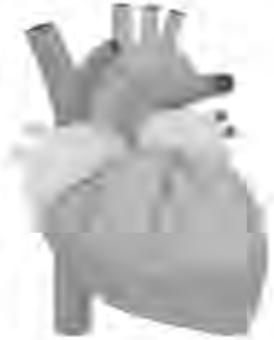
Given below is the diagram showing external view of human heart. Read the information and fill in the blanks:
The human heart, a vital organ, pumps blood throughout the body. It is conical in shape, encased in the pericardium. Made of cardiac muscle tissue, it contracts rhythmically to circulate blood. Valves inside regulate blood flow, ensuring unidirectional movement.
The heart is a muscular organ located slightly towards the (i) __________ side of the chest cavity. It is divided into four chambers: two upper chambers and two lower chambers called as $\qquad$ (ii) __________ . The right atrium receives deoxygenated blood from the body through the (iii) __________ The left atrium receives axygenated blood from the lungs through the (iv) __________ . Blood is pumped from the right ventricle to the lungs through the (v) __________ -

Image
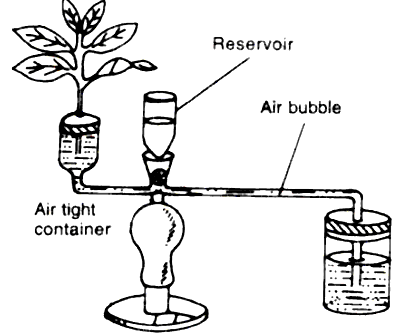
The diagram given alongside is an apparatus used to study a particular phenomenon in plants.
(i) Name the apparatus.
(ii) What is it used for?
(iii) What is the role played by the air bubble in this experiment?
(iv) Of what use is the reservoir?
Photosynthesis in green plants is directly and indirectly dependent on so many plant structures.
Explain briefly the role of the following structures in this process is Phloem tissue in the leaf veins.
Give Reasons for the following:
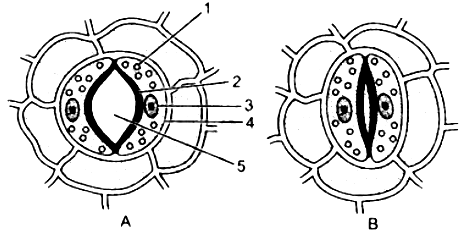
Guard cells are small in size and are kidney-shaped in outline.
Given below are the diagrams of a certain structure in plants in two conditions.

(i) Name the structure shown.
(ii) Name the parts numbered 1-5.
(iii) What is the most apparent difference between A and B in the structure shown?
(iv) Describe the mechanism which brings about the change in the structure depicted in A and B.
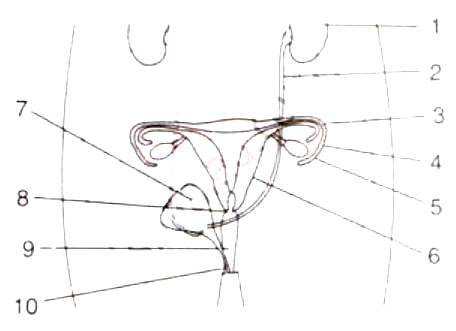
Given below is a diagram of two systems together in the human body.
Describe the functions of the parts 3, 4, 5 and 6.
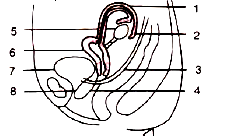
The following diagram represents the vertical sectional view of the human female reproductive system.

Label the parts indicated by the guidelines 1 to 8.
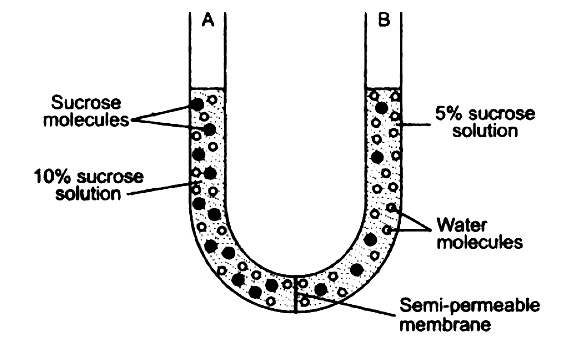
The diagram given below is of an experiment just at the start. Study the diagram carefully and answer the following questions :

(i) What does the experiment demonstrate?
(ii) Define, the process demonstrated in the experiment.
(iii) What changes are observed after a few hours?
(iv) Give two examples of a semi-permeable membrane.
(v) Which limb of the U-tube contains a more concentrated sucrose solution, A or B?
(vi) Why is the membrane separating the two solutions labeled as semi-permeable membrane?