MCQ
Out of the following hybrid orbitals, the one which forms the bond at angle ${120^o}$, is
  • A
    ${d^2}s{p^3}$
  • B
    $s{p^3}$
  • $s{p^2}$
  • D
    $sp$

Answer

Correct option: C.
$s{p^2}$
c
The bond angle of $sp _3$ is $109.5, sp _2$ is $120$ and $sp$ is $180$ . An $sp$ orbital is half $s$ character, $sp _2$ is $\frac{1}{3} s$ character and $sp _3$ is $\frac{1}{4} s$ character, so increasing the $s$ character corresponds to increasing the bond angle.

Need a full question paper?

Generate a complete, print-ready paper with questions like this in minutes — across 16+ boards, with answer keys.

Start Generating Free

Similar questions

In which of the following curved arrows $(cordarrow)$ are not correctly mentioned to show the movement of electrons in drawing resonating structures ?
Predict the correct intermediate, and product in the following reaction $\text{H}_3\text{C}-\text{C}\equiv\text{CH}\xrightarrow[\text{HgSO}_4]{\text{H}_2\text{O},\text{ H}_2\text{SO}_4}\text{intermediate}\rightarrow\text{product}\\ \ \ \ \ \ \ \ \ \ \ \ \ \ \ \ \ \ \ \ \ \ \ \ \ \ \ \ \ \ \ \ \ \ \ \ \ \ \ \ \ \ \ \ \ \ \ \ \ \ \ \ \ \ \text{'A'}\ \ \ \ \ \ \ \ \ \ \ \ \ \ \ \ \ \ \ \ \text{'B'}$
The reaction of toluene with $Cl_2$ in presence of $FeCl_3$ gives $X$ and reaction in presence of light gives $Y.$ Thus, $X$ and $Y$ are
Calculate the millimoles of $SeO_3^{2-}$ in solution on the basis of following data : $70\,ml$ of $\frac{M}{60}$ solution of $KBrO_3$ was added to $SeO_3^{2-}$ solution. The bromine evolved was removed by boiling and excess of $KBrO_3$ was back titrated with $12.5\, mL$ of $\frac{M}{25}$ solution of $NaAsO_2$. The reactions are given below.

$I.\,SeO_3^{2 - } + BrO_3^ -  + {H^ + } \to SeO_4^{2 - } + B{r_2} + {H_2}O$

$II.\,BrO_3^ -  + AsO_2^ -  + {H_2}O \to B{r^ - } + AsO_4^{3 - } + {H^ + }$
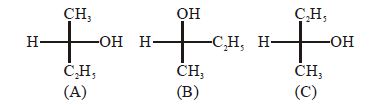
The correct statements about compounds $A, B$ and $C$ is/are
The increasing order of reduction of alkyl halides with zinc and dilute $\ce{HCl}$ is :
Experiment shows that ${H_2}O$ has a dipole moment while $C{O_2}$ has not. Point out the structures which best illustrate these facts
How do we differentiate between $\mathrm{Fe}^{3+}$ and $\mathrm{Cr}^{3+}$ in group $\text{III}\ ?$
A substance which gives brick red flame and breaks down on heating to give oxygen and brown gas is :
The equilibrium constants for the reaction, $\text{Zn(s)}+\text{Cu}^{2+}(\text{aq})\rightleftharpoons\text{Zn}^{2+}(\text{aq})+\text{Cu}(\text{s})$ and
$\text{Cu(s)}+2\text{Ag}^+(\text{aq})\rightleftharpoons\text{Cu}^{2+}(\text{aq})+2\text{Ag(s)}$ are $\text{K}_1$ and $\text{K}_2$ respectively. The equilibrium constant for the combined reaction is,