MCQ
Out of the following which are chiral?
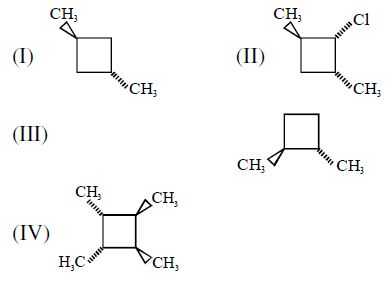
- A$I, II, III$
- B$I, III, IV$
- ✓$II, III$
- D$II, III, IV$
Generate a complete, print-ready paper with questions like this in minutes — across 16+ boards, with answer keys.
$A$. $\mathrm{Ti}^{3+}$ $B$. $\mathrm{Cr}^{2+}$ $C$. $\mathrm{Mn}^{2+}$ $D$.$\mathrm{Fe}^{2+}$ $E$. $\mathrm{Sc}^{3+}$
Choose the most appropriate answer from the options given below.
$(C= 3 \times 10^8 \,ms^{-1}$ and $N_A =6.02 \times mol^{-1}).$
$Ca_3(PO_4)_2 + SiO_2 + C + O_2 + H_2O \to CaSiO_3 + CO_2 + H_3PO_4$
If $1.0\ kg$ each of calcium phosphate and silica are used with excess of $C$ , $O_2$ and $H_2O$ , what is maximum quantity of phosphoric acid that can be produced. $(Ca = 40, P = 31, Si = 28)$
Assertion $A$ : Aniline on nitration yields ortho, meta and para nitro derivatives of aniline.
Reason $R$: Nitrating mixture is a strong acidic mixture.
In the light of the above statements, choose the correct answer from the options given below