MCQ
Out of the following which pair of quantities do not have same dimensions
  • A
    Planck's constant and angular momentum
  • B
    Work and energy
  • C
    Pressure and Young's modulus
  • Torque & moment of inertia

Answer

Correct option: D.
Torque & moment of inertia
d
(d) Torque = $[M{L^2}{T^{ - 2}}]$, Moment of inertia = $[M{L^2}]$

Need a full question paper?

Generate a complete, print-ready paper with questions like this in minutes — across 16+ boards, with answer keys.
Start Generating Free

Similar questions

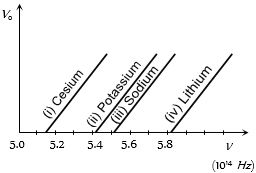
The figure shows different graphs between stopping potential $({V_0})$ and frequency $(v)$ for photosensitive surface of cesium, potassium, sodium and lithium. The plots are parallel. Correct ranking of the targets according to their work function greatest first will be
$Assertion$ : In a free fall, weight of a body becomes effectively zero.

$Reason$ : Acceleration due to gravity acting on a body having free fall is zero.
The refractive index of water with respect to air is $4 / 3$ and the refractive index of glass with respect to air is $3/2$. The refractive index of water with respect to glass is
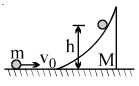
A particle of mass $m$ moving horizontally with $v_0$ strikes $a$ smooth wedge of mass $M$, as shown in figure. After collision, the ball starts moving up the inclined face of the wedge and rises to $a$ height $h$. The maximum height h attained by the particle is 
A radioactive nucleus is being produced at a constant rate $\alpha$ per second. Its decay constant is $\lambda $. If $N_0$ are the number of nuclei at time $t = 0$, then maximum number of nuclei possible are
In which of the following compounds the methylenic hydrogens are the most acidic ?
The magnetic moment has dimensions of
A ball is projected from the ground at an angle of $45^{\circ}$ with the horizontal surface. It reaches a maximum height of $120 m$ and returns to the ground. Upon hitting the ground for the first time, it loses half of its kinetic energy. Immediately after the bounce, the velocity of the ball makes an angle of $30^{\circ}$ with the horizontal surface. The maximum height it reaches after the bounce, in metres, is. . . . .
A large cylindrical rod of length $L$ is made by joining two identical rods of copper and steel of length $(\frac {L}{2})$ each . The rods are completely insulated from the surroundings. If the free end of copper rod is maintained at $100\,^oC$ and that of steel at $0\,^oC$ then the temperature of junction is........$^oC$ (Thermal conductivity of copper is $9\,times$ that of steel)
The stopping potential for photoelectrons emitted from a surface illuminated by light of wavelength $6630 \; \mathring A$ is $0.42 \; V$. If the threshold frequency is $x \times$ $10^{13}  / s$, where $x$ is$\dots$ (nearest integer).

(Given, speed light $=3 \times 10^{8} \; m / s$, Planck's constant $=6.63 \times 10^{-34} \; Js$ )