MCQ
Out of the following which pair of quantities do not have same dimensions
  • A
    Planck's constant and angular momentum
  • B
    Work and energy
  • C
    Pressure and Young's modulus
  • Torque & moment of inertia

Answer

Correct option: D.
Torque & moment of inertia
d
(d) Torque = $[M{L^2}{T^{ - 2}}]$, Moment of inertia = $[M{L^2}]$

Need a full question paper?

Generate a complete, print-ready paper with questions like this in minutes — across 16+ boards, with answer keys.
Start Generating Free

Similar questions

A solid cylinder rolls down an inclined plane from a height $h$. At any moment the ratio of rotational kinetic energy to the total kinetic energy would be 
$300 \,gm$ of water at $25^{\circ} C$ is added to $100 \,gm$ of ice at $0^{\circ} C$. The final temperature of the mixture is ........... $^{\circ} C$
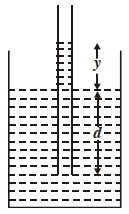
A drinking straw is dipped in a pan of water to depth d from the surface (see figure below). Now water is sucked into it up to an initial height $h_0$ and then left to oscillate. As a result, its height $y$ from the surface of the water varies periodically. Ignoring damping, the equation for $y$ is ( $g$ is the acceleration due to gravity):
A hockey player is moving northward and suddenly turns westward with the same speed to avoid an opponent. The force that acts on the player is:
  1. Frictional force along westward.
  2. Muscle force along southward.
  3. Frictional force along south-west.
  4. Muscle force along south-west.
The orbital speed of a satellite revolving around a planet in a circular orbit is $v_0$. If its speed is increased by $10 \%$, then ..........
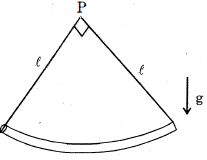
A circular arc of mass $m$ is connected with the help of two massless strings as shown in the figuw in vertical plane. About point $P$, small oscillations are given in the plane of the arc. Time period of the oscillations of $SHM$ will be
Two stones having different masses $m_1$ and $m_2$ are projected at an angle $\alpha$ and $\left(90^{\circ}-\alpha\right)$ with same speed from same point. The ratio of their maximum heights is
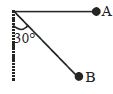
A simple pendulum is released from $A$ as shown in figure. If $m$ and $l$ represent the mass of the $bob$ and the length of the pendulum respectively, the gain in kinetic energy at $B$ is
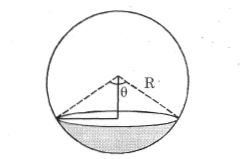
Consider a spherical drop of radius $R$. Surface tension of the liquid is $\sigma$ . Force of surface tension on shaded sub hemisphere due to remaining drop is $0.5\,\pi \sigma R$ . The value of- angle $\theta$ (angle subtended hy the sub hemisphere at centre of drop) is ......$^o$
$A$ particle of mass $3m$ is projected from the ground at some angle with horizontal. The horizontal range is $R$. At the highest point of its path it breaks into two pieces $m$ and $2m$. The smaller mass comes to rest and larger mass finally falls at a distance $x$ from the point of projection where $x$ is equal to