Question
Out of the given matrices, choose that matrix which is a scalar matrix:
  1. $\begin{bmatrix}0&0\\0&0\end{bmatrix}$
  2. $\begin{bmatrix}0&0&0\\0&0&0\end{bmatrix}$
  3. $\begin{bmatrix}0&0\\0&0\\0&0\end{bmatrix}$
  4. $\begin{bmatrix}0\\0\\0\end{bmatrix}$

Answer

  1. $\begin{bmatrix}0&0\\0&0\end{bmatrix}$
Solution:
A diagonal matrix with all diagonal elements are equal is a scalar matrix.

Need a full question paper?

Generate a complete, print-ready paper with questions like this in minutes — across 16+ boards, with answer keys.

Start Generating Free

Similar questions

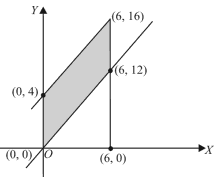
The feasible region for an LPP is shown shaded in the figure. Let $F=3 x-4 y$ be the objective function.
Minimum value of $F$ is
Image
If a vector makes an angle of $\frac{\pi}{4}$ with the positive directions of both x-axis and y-axis, then the angle which it makes with positive z-axis is:
If the direction cosines of a line are $\Big(\frac{1}{\text{c}},\frac{1}{\text{c}},\frac{1}{\text{c}}\Big)$ then:
  1. 0 < c < 1
  2. c > 2
  3. $\text{c}=\underline{+}\sqrt{2}$
  4. None of these
A line passes through the points (6, −7, −1) and (2, −3, 1). The direction cosines of the line so directed that the angle made by it with the positive direction of x-axis is acute, is?
If A is a 2-rowed square matrix and IAI = 6 then A adj A = ?
The derivative of $\sec^{-1}\Big(\frac{1}{2\text{x}^2+1}\Big)$ w.r.t. $\sqrt{1+3\text{x}}$ at $\text{x}=\frac{-1}{3}$
  1. $\text{Does not exist.}$
  2. $0$
  3. $\frac{1}{2}$
  4. $\frac{1}{3}$
$\int\sec^2\text{x}.\text{cosec}^2\text{xdx}=$
  1. $\tan\text{x}-\cot\text{x+c}$
  2. $\tan\text{x}+\cot\text{x+c}$
  3. $-\tan\text{x}+\cot\text{x+c}$
  4. $\sec\text{x}\tan\text{x+c}$
A stone throw upward having speed equation $S =9.8 t-4.9 t^2$ where S in $m / s$. What will be the time to achieve maximum height ?
If $\text{x }\epsilon\Big(-\frac{\pi}{2},\frac{\pi}{2}\Big),$ then the value of $\tan^{-1}\Big(\frac{\tan\text{x}}{4}\Big)+\tan^{-1}\Big(\frac{3\sin2\text{x}}{5+3\cos2\text{x}}\Big)$ is:
  1. $\frac{\text{x}}{2}$
  2. 2x
  3. 3x
  4. x
If $\text{y}=\text{a}\cos(\log_\text{e}\text{x})+\text{b}\sin(\log_\text{e}\text{x})$ then $\text{x}^2\text{y}^2+\text{xy}_1=$
  1. 0
  2. y
  3. -y
  4. None of these