Question
Out of the two magnetic materials, 'A' has relative permeability slightly greater than unity while 'B' has less than unity. Identify the nature of the materials 'A' and 'B'. Will their susceptibilities be positive or negative?

Answer

A: Paramagnetic
B: Diamagnetic
Susceptibility:
For A: positive
For B: negative.

Need a full question paper?

Generate a complete, print-ready paper with questions like this in minutes — across 16+ boards, with answer keys.

Start Generating Free

Similar questions

Radio waves are produced by the accelerated motion of charges in conducting wires. Microwaves are produced by special vacuum tubes. Infrared waves are produced by hot bodies and molecules also known as heat waves. UV rays are produced by special lamps and very hot bodies like Sun.
  1. Solar radiation is:
  1. Transverse electromagnetic wave.
  2. Longitudinal electromagnetic waves.
  3. Both longitudinal and transverse electromagnetic waves.
  4. None of these.
  1. What is the cause of greenhouse effect?
  1. Infrared rays.
  2. Ultraviolet rays
  3. X-rays.
  4. Radiowaves.
  1. Biological importance of ozone layer is:
  1. It stops ultraviolet rays.
  2. It layer reduces greenhouse effect.
  3. It reflects radiowaves.
  4. None of these.
  1. Ozone is found in.
  1. Stratosphere.
  2. Ionosphere.
  3. Mesosphere.
  4. Troposphere.
  1. Earth's atmosphere is richest in.
  1. Ultraviolet.
  2. Infrared.
  3. X-rays.
  4. Microwave.
A magnetic dipole of magnetic moment $0.72A-m^2$ is placed horizontally with the north pole pointing towards bsouth. Find the position of the neutral point if the horizontal component of the earth's magnetic field is $18\mu\text{T.}$
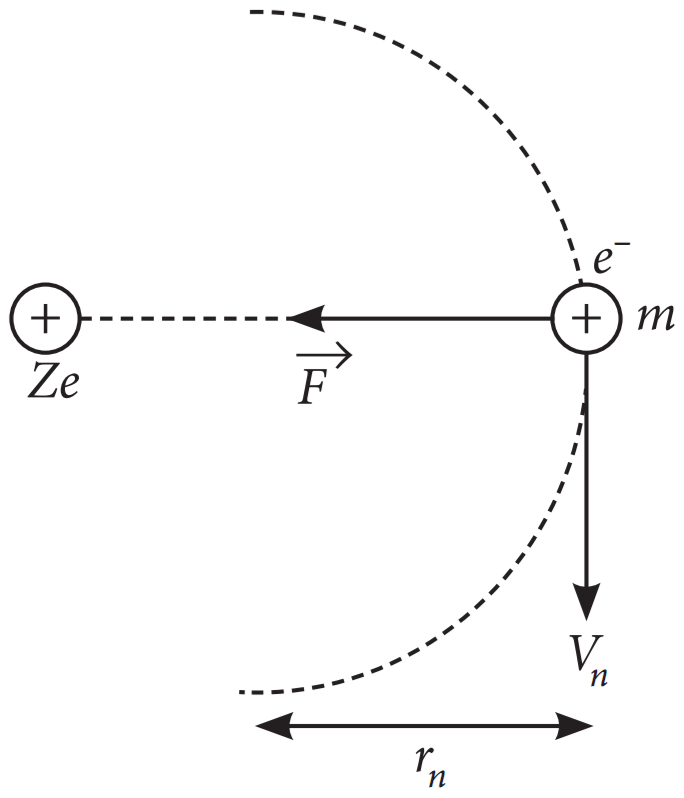
Hydrogen is the simplest atom of nature. There is one proton in its nucleus and an electron moves around the nucleus in a circular orbit. According to Niels Bohr, this electron moves in a stationary orbit. When this electron is in the stationary orbit, it emits no electromagnetic radiation.The angular momentum of the electron is quantized, i.e., ⁣$\text{mvr}=\big(\frac{\text{nh}}{2\pi}\big)$ where m = mass of the electron, v = velocity of the electron in the orbit, r = radius of the orbit and n = 1, 2, 3, .... When transition takes place from $K^{th}$ orbit to $J^{th}$ orbit, energy photon is emitted. If the wavelength of the emitted photon is $\lambda$ we find that $\frac{1}{\lambda}=\text{R}\bigg[\frac{1}{\text{J}^2}-\frac{1}{\text{K}^2}\bigg]$where find that On a different planet, the hydrogen atom's structure was somewhat different from ours. The angular momentum of electron was $\text{P}=2\text{n}\Big(\frac{\text{h}}{2\pi}\Big)$ i.e., an even multiple of $\Big(\frac{\text{h}}{2\pi}\Big)$.
  1. The minimum permissible radius of the orbit will be.
  1. $\frac{2\in_0\text{h}^2}{\text{m}\pi\text{e}^2}$
  2. $\frac{4\in_0\text{h}^2}{\text{m}\pi\text{e}^2}$
  3. $\frac{\in_0\text{h}^2}{\text{m}\pi\text{e}^2}$
  4. $\frac{\in_0\text{h}^2}{\text{2m}\pi\text{e}^2}$
  1. In our world, the velocity of electron is $v_0$ when the hydrogen atom is in the ground state. The velocity of electron in this state on the other planet should be.
  1. $\text{v}_0$
  2. $\frac{\text{v}_0}{2}$
  3. $\frac{\text{v}_0}{4}$
  4. $\frac{\text{v}_0}{8}$
  1. In our world, the ionization potential energy of a hydrogen atom is 13.6eV. On the other planet, this ionization potential energy will be.
  1. 13.6eV
  2. 3.4eV
  3. 1.5eV
  4. 0.85eV
  1. Check the correctness of the following statements about the Bohr model of hydrogen atom.
  1. The acceleration of the electron in n = 2 orbit is more than that in n = 1 orbit.
  2. The angular momentum of the electron in n = 2 orbit is more than that in n = 1 orbit.
  3. The kinetic energy of the electron in n = 2 orbit is less than that in n = 1 orbit.
  1. Only (III) and (I) are correct
  2. Only (III) and (I) are correct
  3. Only (II) and (III) are correct.
  4. All the statements are correct.
  1. In Bohr's model of hydrogen atom, let PE represent potential energy and TE the total energy. In going to a higher orbit.
  1. PE increases, TE decreases
  2. PE decreases, TE increases
  3. PE increases, TE increases
  4. PE decreases, TE decreases
  1. A mobile phone lies along the principal axis of a concave mirror. Show, with the help of a suitable diagram, the formation of its image. Explain why magnification is not uniform.
  2. Suppose the lower half of the concave mirror's reflecting surface is covered with an opaque material. What effect this will have on the image of the object? Explain.
Huygen's principle is the basis of wave theory of light. Each point on a wavefront acts as a fresh source of new disturbance, called secondary waves or wavelets. The secondary wavelets spread out in all directions with the speed light in the given medium. An initially parallel cylindrical beam travels in a medium of refractive index $\mu(\text{I})=\mu_0+\mu_2\text{I}$, where $\mu_0$ and $\mu_2$ are positive constants and I is the intensity of the light beam. The intensity of the beam is decreasing with increasing radius.
  1. The initial shape of the wavefront of the beam is:
  1. Planar.
  2. Convex.
  3. Concave.
  4. Convex near the axis and concave near the periphery.
  1. According to Huygens Principle, the surface of constant phase is:
  1. Called an optical ray.
  2. Called a wave.
  3. Called a wavefront.
  4. Always linear in shape.
  1. As the beam enters the medium, it will:
  1. Travel as a cylindrical beam.
  2. Diverge.
  3. Converge.
  4. Diverge near the axis and converge near the periphery.
  1. Two plane wavefronts oflight, one incident on a thin convex lens and another on the refracting face of a thin prism. After refraction at them, the emerging wavefronts respectively become.
  1. Plane wavefront and plane wavefront.
  2. Plane wavefront and spherical wavefront.
  3. Spherical wavefront and plane wavefront.
  4. Spherical wavefront and spherical wavefront.
  1. Which of the following phenomena support the wave theory of light?
  1. Scattering.
  2. Interference.
  3. Diffraction.
  4. Velocity of light in a denser medium is less than the velocity of light in the rarer medium.
  1. 1, 2, 3
  2. 1, 2, 4
  3. 2, 3, 4
  4. 1, 3, 4
Mutual inductance is the phenomenon of inducing emfina coil, due to a change of current in the neighbouring coil. The amount of mutual inductance that links one coil to another depends very much on the relative positioning of the two coils, their geometry and relative separation between them. Mutual inductance between the two coils increases ft, times if the coils are wound over an iron core of relative permeability.
  1. A short solenoid of radius a, number of turns per unit length $n_1$, and length L is kept coaxially inside a very long solenoid of radius b, number of turns per unit length $n_2$. What is the mutual inductance of the system?
  1. $\mu_0\pi\text{b}^2\text{n}_1\text{n}_2\text{L}$
  2. $\mu_0\pi\text{a}^2\text{n}_1\text{n}_2\text{L}^2$
  3. $\mu_0\pi\text{a}^2\text{n}_1\text{n}_2\text{L}$
  4. $\mu_0\pi\text{b}^2\text{n}_1\text{n}_2\text{L}^2$
  1. If a change in current of 0.01A in one coil produces a change in magnetic flux of $2 \times 10^{-2}$ weber in another coil, then the mutual inductance between coils is:
  1. 0
  2. 0.5H
  3. 2H
  4. 3H
  1. Mutual inductance of two coils can be increased by:
  1. Decreasing the number of turns in the coils.
  2. Increasing the number of turns in the coils.
  3. Winding the coils on wooden cores.
  4. None of these.
  1. When a sheet of iron is placed in between the two co-axial coils, then the mutual inductance between the coils will:
  1. Increase.
  2. Decrease.
  3. Remains same.
  4. Cannot be predicted.
  1. The SJ unit of mutual inductance is:
  1. Ohm.
  2. Mho.
  3. Henry.
  4. None of these.
Out of the two magnetic materials, 'A' has relative permeability slightly greater than unity while oB' has less than unity. Identify the nature of the materials 'A' and 'B'. Will their susceptibilities be positive or negative?
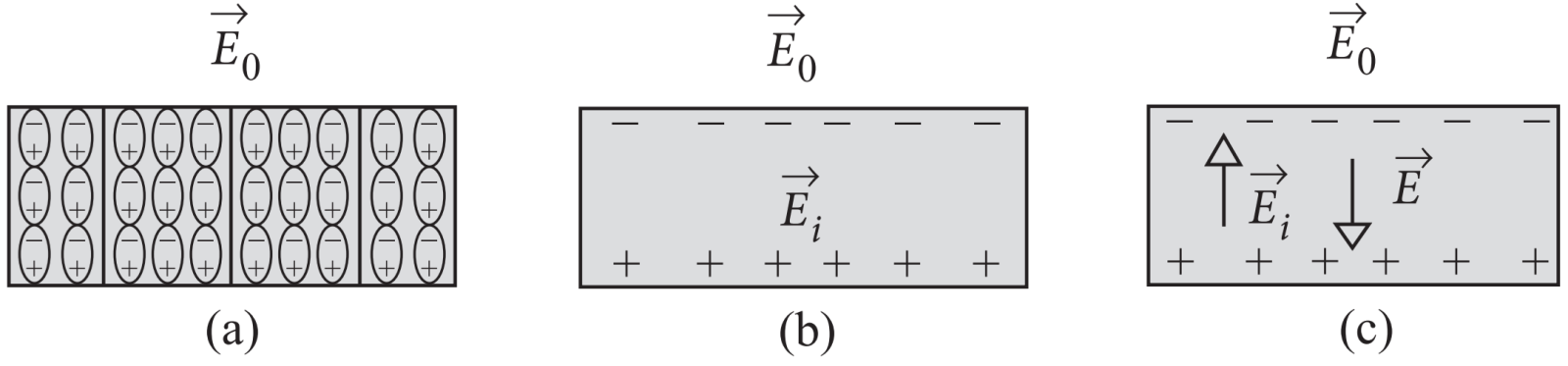
When an insulator is placed in an external field, the dipoles become aligned. Induced surface charges on the insulator establish a polarization field $\vec{\text{E}}_\text{i}$ in its interior. The net field $\vec{\text{E}}$ in the insulator is the vector sum of $\vec{\text{E}}_0$ and $\vec{\text{E}}_\text{i}$ as shown in the figure.

On the application of external electric field, the effect of aligning the electric dipoles in the insulator is called polarisation, and the field $\vec{\text{E}}_\text{i}$ is known as the polarisation field. The dipole moment per unit volume of the dielectric is known as polarisation $(\vec{\text{P}}).$ For linear isotropic dielectrics, $\vec{\text{P}}=\chi\vec{\text{E}},$ where $\chi=$ electrical susceptibility of the dielectric medium.
  1. Which among the following is an example of polar molecule?
  1. $O_2$
  2. $H_2$
  3. $N_2$
  4. $HCI$
  1. When air is replaced by a dielectric medium of constant K, the maximum force of attraction between two charges separated by a distance:
  1. Increases K times.
  2. Remains unchanged.
  3. Decreases K times.
  4. Increases 2K times.
  1. Which of the following is a dielectric?
  1. Copper.
  2. Glass.
  3. Antimony (Sb).
  4. None of these.
  1. For a polar molecule, which of the following statements is true?
  1. The centre of gravity of electrons and protons coincide.
  2. The centre of gravity of electrons and protons do not coincide.
  3. The charge distribution is always symmetrical.
  4. The dipole moment is always zero.
  1. When a comb rubbed with dry hair attracts pieces of paper. This is because the?
  1. Comb polarizes the piece of paper.
  2. Comb induces a net dipole moment opposite to the direction of field.
  3. Electric field due to the comb is uniform.
  4. Comb induces a net dipole moment perpendicular to the direction of field.
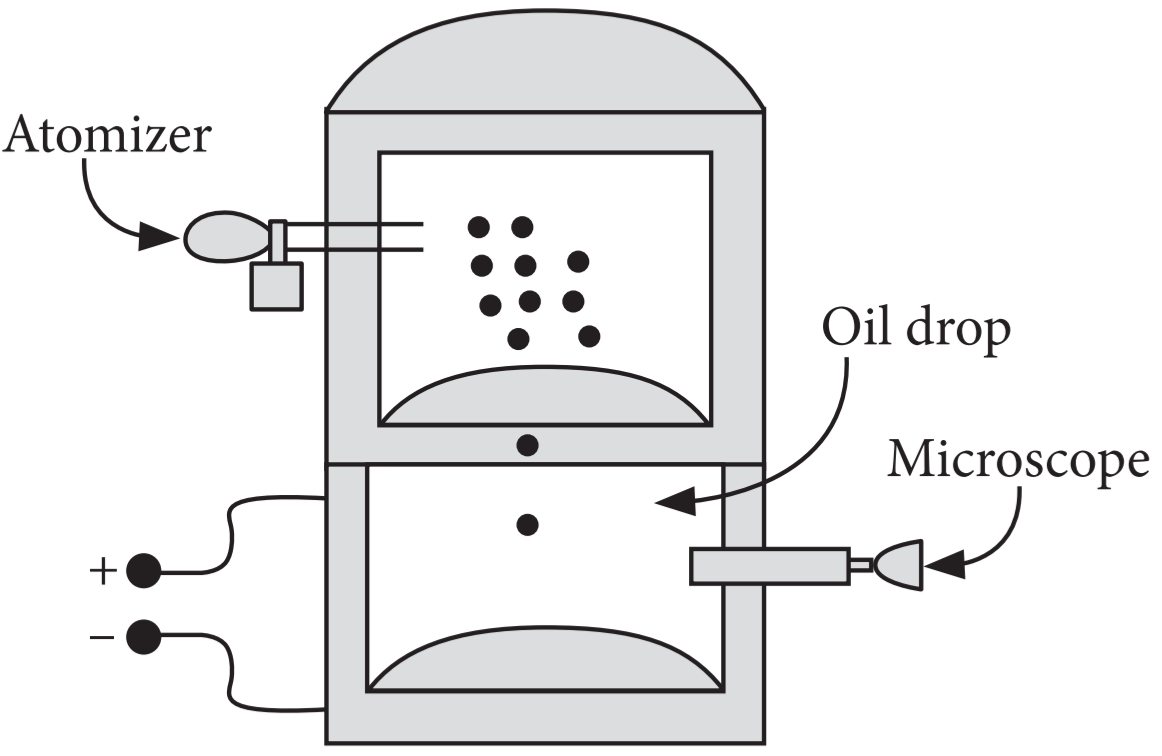
In 1909, Robert Millikan was the first to find the charge of an electron in his now-famous oil-drop experiment. In that experiment, tiny oil drops were sprayed into a uniform electric field between a horizontal pair of oppositely charged plates. The drops were observed with a magnifying eyepiece, and the electric field was adjusted so that the upward force on some negatively charged oil drops was just sufficient to balance the downward force of gravity. That is, when suspended, upward force qE just equaled Mg. Millikan accurately measured the charges on many oil drops and found the values to be whole number multiples of $1.6 \times 10^{-19}C$ the charge of the electron. For this, he won the Nobel Prize.
  1. If a drop of mass $1.08 \times 10^{-14}kg$ remains stationary in an electric field of $1.68 \times 10^5NC^{-1},$ then the charge of this drop is:
  1. $6.40 \times 10^{-19}C$
  2. $3.2 \times 10^{-19}C$
  3. $1.6 \times 10^{-19}C$
  4. $4.8 \times 10^{-19}C$
  1. Extra electrons on this particular oil drop (given the presently known charge of the electron) are:
  1. 4
  2. 3
  3. 5
  4. 8
  1. A negatively charged oil drop is prevented from falling under gravity by applying a vertical electric field $100V\  m^{-1}.$ If the mass of the drop is $1.6 \times 10^{-3}g,$ the number of electrons carried by the drop is$ (g = 10m s^{-2})$
  1. $10^{18}$
  2. $10^{15}$
  3. $10^{12}$
  4. $10^9$
  1. The important conclusion given by Millikan's experiment about the charge is:
  1. Charge is never quantized.
  2. Charge has no definite value.
  3. Charge is quantized.
  4. Charge on oil drop always increases.
  1. If in Millikan's oil drop experiment, charges on drops are found to be $8\mu\text{C, }12\mu\text{C, }20\mu\text{C, }$ then quanta of charge is:
  1. $8\mu\text{C}$
  2. $20\mu\text{C}$
  3. $12\mu\text{C}$
  4. $4\mu\text{C}$
In the year 1939, German scientist Otto Hahn and Strassmann discovered that when an uranium isotope was bombarded with a neutron, it breaks into two intermediate mass fragments. It was observed that, the sum of the masses of new fragments formed were less than the mass of the original nuclei. This difference in the mass appeared as the energy released in the process. Thus, the phenomenon of splitting of a heavy nucleus (usually A > 230) into two or more lighter nuclei by the bombardment of proton, neutron $\alpha$-particle, etc. with liberation of energy is called nuclear fission.
$\ _{92}\text{U}^{235}+\ _0\text{n}^{1}\rightarrow_{92}\text{U}^{236} \rightarrow\ _{56}\text{B}^{114}+\ _{36}\text{Kr}^{89}\ +3\ _{0}\text{n}^{1} + \text{Q}$
$\big[\because \ _{92}\text{U}^{236}= \text{Unstable nucleus}\big]$
  1. Nuclear fission can be explained on the basis of.
  1. Millikan's oil drop method
  2. Liquid drop model
  3. Shell model
  4. Bohr's model.
  1. For sustaining the nuclear fission chain reaction in a sample (of small size) of $_{92}^{235}\text{U}$ it is desirable to slow down fast neutrons by.
  1. Friction
  2. Elastic damping/ scattering
  3. Absorption
  4. None of these.
  1. Which of the following is/ are fission reaction(s)?
  1. $_0^1\text{n}\ +\ _{92}^{235}\text{U}\rightarrow\ _{92}^{235}\text{U}\rightarrow\ _{51}^{133}\text{Sb}+\ _{41}^{99}\text{nb}+\ 4_1^0\text{n}$
  2. $_0^1\text{n}\ +\ _{92}^{235}\text{U}\rightarrow\ _{54}^{1.40}\text{Xe}+\ _{38}^{94}\text{Sr}\ +2_0^1\text{n}$
  3. $_1^2\text{H}\ +\ _1^2\text{H}\rightarrow\ _2^3\text{He}+\ _0^1\text{n}$
  1. Both II and III
  2. Both I and III
  3. Only II
  4. Both I and II
  1. On an average, the number of neutrons and the energy of a neutron released per fission of a uranium atom are respectively.
  1. 2.5 and 2 keV
  2. 3 and 1 keV
  3. 2.5 and 2 MeV
  4. 2 and 2 keV
  1. In any fission process, ratio of mass of daughter nucleus to mass of parent nucleus is.
  1. Less than I
  2. Greater than I
  3. Equal to I
  4. Depends o the mass of parent nucleus.