MCQ
Outermost electronic configuration of a group $13$ element, $E$, is $4 \,\mathrm{~s}^{2}, 4 p^{1}$. The electronic configuration of an element of $p$-block period-five placed diagonally to element, $E$ is :
  • A
    $[\mathrm{Xe}]{5} \mathrm{~d}^{10} 6 \mathrm{~s}^{2} 6 \mathrm{p}^{2}$
  • $[\mathrm{Kr}] 4 \mathrm{~d}^{10} 5 \mathrm{~s}^{2} 5 \mathrm{p}^{2}$
  • C
    $[\mathrm{Kr}] 3 \mathrm{~d}^{10} 4 \mathrm{~s}^{2} 4 \mathrm{p}^{2}$
  • D
    $ [Ar]$ $3 d^{10} 4 s^{2} 4 p^{2}$

Answer

Correct option: B.
$[\mathrm{Kr}] 4 \mathrm{~d}^{10} 5 \mathrm{~s}^{2} 5 \mathrm{p}^{2}$
b
The element $\mathrm{E}$ is $\mathrm{Ga}$ and the diagonal element of $5^{\mathrm{th}}$ period is ${ }_{50} \mathrm{Sn}$ having outer electronic configuration will be $[\mathrm{Kr}] \,5 \mathrm{~s}^{2} \,4 \mathrm{~d}^{10}\, 5 \mathrm{p}^{2}$.

Need a full question paper?

Generate a complete, print-ready paper with questions like this in minutes — across 16+ boards, with answer keys.

Start Generating Free

Similar questions

The molecular shapes of $S{F_4},\,C{F_4}$ and $Xe{F_4}$ are
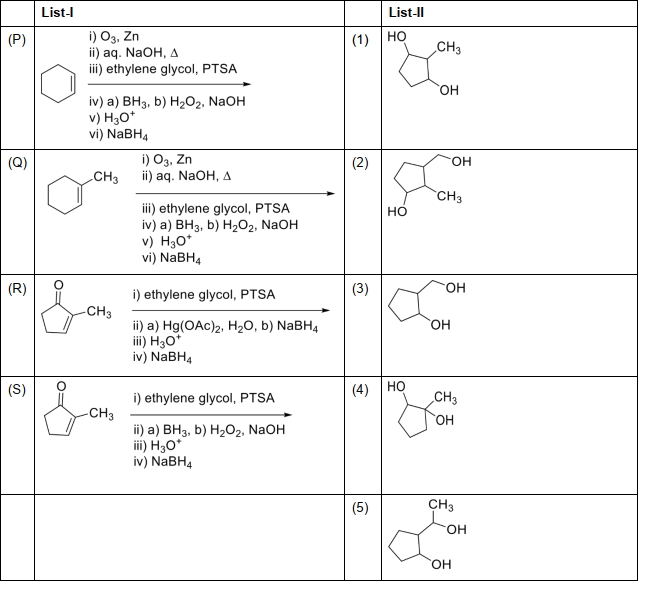
$List-I$ contains various reaction sequences and $List-II$ contains the possible products. Match each entry in $List-I$ with the appropriate entry in $List-II$ and choose the correct option.
Beryllium shows diagonal relationship with
Assertion : Equal moles of different substances contain same number of constituent particles.
Reason : Equal weights of different substances contain the same number of constituent particles.
Catalytic hydrogenation of benzene gives
Ammonium ion is
Compound $(C)$ in above sequence of reaction is
Consider the following information about element $P$ and $Q$ 

  Period number Group number
$Q$ $2$ $15$
$P$ $3$ $2$

Then formula of the compound formed by $P$ and $Q$ element is

The ground state electronic configurations of the elements, $U, V, W, X,$ and $Y$ (these symbols do not have any chemical significance) are as follows

$U\,\,\, 1s^2 \,2s^2 \,2p^3$
$V\,\,\, 1s^2\,2s^2 \,2p^6 \,3s^1$
$W\,\,\, 1s^2\,2s^2\, 2p^6\,3s^2\,3p^2$
$X\,\,\, 1s^2\,2s^2\,2p^6\,3s^2\,3p^6\,3d^5\, 4s^2$
$Y\,\,\, 1s^2\, 2s^2\,2p^6\,3s^2\,3p^6\,3d^{10}\, 4s^2\, 4p^6$

Determine which sequence of elements satisfy the following statements :
$(i)$ Element forms a carbonate which is not decomposed by heating
$(ii)$ Element is most likely to form coloured ionic compounds
$(iii)$ Element has largest atomic radius
$(iv)$ Element forms only acidic oxide

The least reactive alkane towards free-radical substitution reactions is: