Question
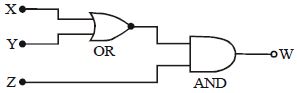
Output $W$ is given by

Answer

Get the step-by-step solution for this question inside the Vidyadip app.

Get the answer in the app

Need a full question paper?

Generate a complete, print-ready paper with questions like this in minutes — across 16+ boards, with answer keys.
Start Generating Free

Similar questions

A body starts from rest from the origin with an acceleration of $6\,m/{s^2}$ along the $x-$axis and $8\,m/{s^2}$ along the $y-$axis. Its distance from the origin after $4 \,seconds$ will be........$m$
A vector $\vec Q$ which has a magnitude of $8$ is added to the vector $\vec P$ which lies along $x-$ axis. The resultant of two vectors lies along $y-$ axis and has magnitude twice that of  $\vec P$. The magnitude of is $\vec P$
The ratio of the longest to shortest wavelengths in Brackett series of hydrogen spectra is
“Stationary waves” are so called because in them
A homogeneous electric field $E$ and a uniform magnetic field $\mathop B\limits^ \to $ are pointing in the same direction. A proton is projected with its velocity parallel to $\mathop E\limits^ \to $. It will
The observed wavelength of light coming from a distant galaxy is found to be increased by $0.5\%$ as compared with that coming from a terrestrial source. The galaxy is
The trajectory of a projectile near the surface of the earth is given as $ y = 2x -9x^2$. If it were launched at an angle $\theta_0$ with speed $v_0$ then $(g = 10\, ms^{-2})$
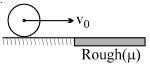
$A$ ring of mass $M$ and radius $R$ sliding with a velocity $v_0$ suddenly enters into rough surface where the coefficient of friction is $\mu$ , as shown in figure.  Choose the correct statement $(s)$
A students measures the distance traversed in free fall of a body, the initially at rest, in a given time. He uses this data to estimate $g$ , the acceleration due to gravity . If the maximum percentage errors in measurement of the distance and the time are $e_1$ and $e_2$ respectively, the percentage error in the estimation of $g$ is 
A street car moves rectilinearly from station $A$ to the next station $B$ with an acceleration varying according to the law $a=(b-c x)$, where $b$ and $c$ are constants and $x$ is the distance from station $A$. The distance between the two stations and the maximum velocity are