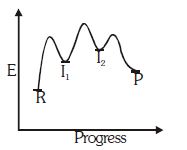
Question
Oxidation number of carbon in ${H_2}{C_2}{O_4}$ is
$2 + 2x - 2 \times 4 = 0$; $2x = 8 - 2 = 6$
$x = \frac{6}{2} = + 3$.
Generate a complete, print-ready paper with questions like this in minutes — across 16+ boards, with answer keys.
$Fe(OH)_{3(s)} \rightleftharpoons Fe^{3+}_{(aq)} + 3OH^-_{(aq)}$
is decreased by $1/4$ times, then equilibrium concentration of $Fe^{3+}$ will increase by.....$ times$
$\mathrm{H}_2 \mathrm{O}_2, \mathrm{ClO}_3^{-}, \mathrm{P}_4, \mathrm{Cl}_2, \mathrm{Ag}, \mathrm{Cu}^{+1}, \mathrm{~F}_2, \mathrm{NO}_2, \mathrm{~K}^{+}$
Given : Mass of electrons $=9.1 \times 10^{-31}\, \mathrm{~kg}$
Charge on an electron $=1.6 \times 10^{-19}\, \mathrm{C}$
Planck's constant $=6.63 \times 10^{-34\,} \mathrm{Js}$
$\left[\right.$ Given : $K _{ sp }( AgBr )=4.9 \times 10^{-13}$ at $298 K$
$\lambda_{ Ag ^{+}}^0=6 \times 10^{-3} Sm ^2\,mol ^{-1}$
$\lambda_{ Br ^{-}}^0=8 \times 10^{-3} Sm ^2\,mol ^{-1}$
$\left.\lambda_{ NO _3^{-}}^0=7 \times 10^{-3} Sm ^2\,mol ^{-1}\right]$