Respiration In Plants — BIOLOGY STD 11 Science — Question
Gujarat BoardEnglish MediumSTD 11 ScienceBIOLOGYRespiration In Plants5 Marks
Question
Oxygen is critical for aerobic respiration. Explain its role with respect to ETS.
✓
Answer
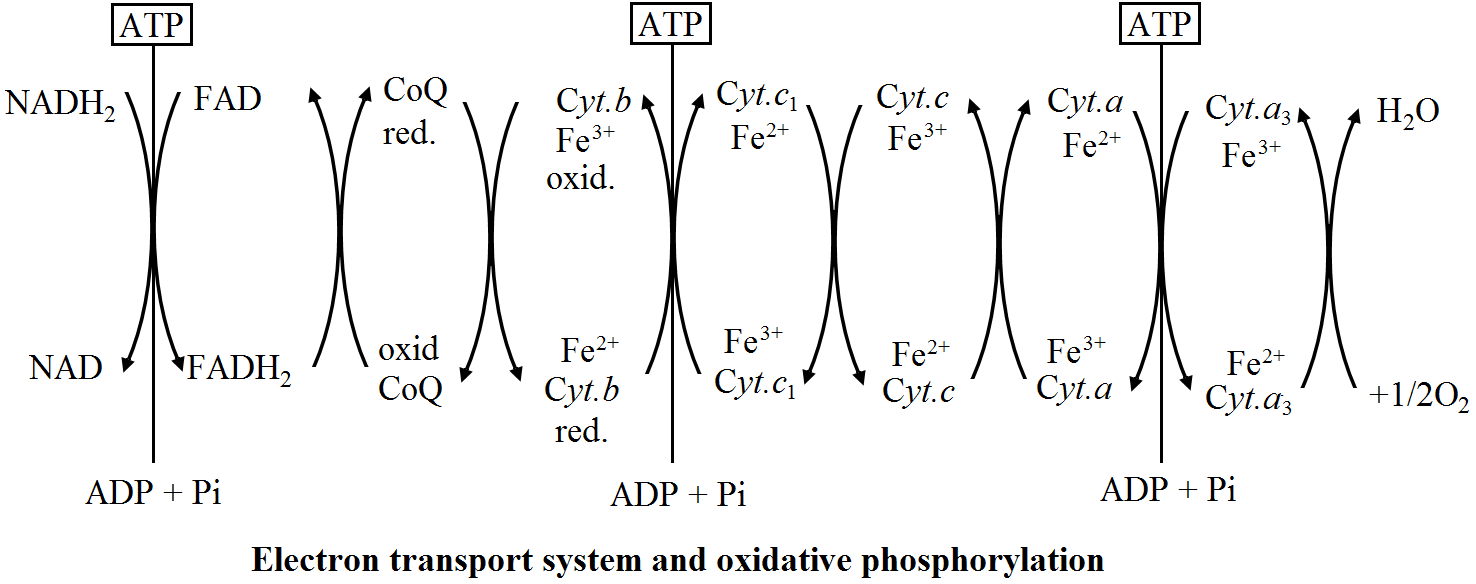
The oxidation of glucose starts with glycolysis in cytoplasm, and then followed by Krebs' cycle in matrix of mitochondria and finally electron transport chain (ETC) in inner mitochondrial membrane. The requirement of oxygen is at the end of ETC. An electron transport chain or system is a series of coenzymes arid cytochromes that take part in passage of electrons from a chemical to its ultimate acceptor. At the end of electron transport chain the electrons are given to oxygen. At the same time oxygen accepts hydrogen ions to form water. This happens in the matrix, on the surface of the inner membrane. This is the only stage at which oxygen is used in cell respiration. If oxygen is not available, electron flow along the electron transport chain stops and NADH $+\mathrm{H}^{+}$cannot be reconverted to $\mathrm{NAD}^{+}$. Supplies of $\mathrm{NAD}^{+}$in the mitochondrion run out and the link reaction and Krebs' cycle cannot continue. Glycolysis can continue because conversion of pyruvate into lactate or ethanol and carbon dioxide produces as much $\mathrm{NAD}^{+}$as is used in glycolysis. Whereas aerobic respiration gives a yield of about 38 ATP molecules per glucose, glycolysis produces only two. Oxygen thus greatly increases the ATP yield. The figure (below) shows the electron transport chain and the role of oxygen as terminal electron accepter.
Need a full question paper?
Generate a complete, print-ready paper with questions like this in minutes — across 16+ boards, with answer keys.