MCQ
Oxygen was discovered by
  • Priestley
  • B
    Boyle
  • C
    Scheele
  • D
    Cavandish

Answer

Correct option: A.
Priestley
a
Oxygen is discovered by joseph Priestley in wilt shire, England in $1772$.

The name of Oxygen comes from the Greek'Oxygenes meaning acidforming.

Need a full question paper?

Generate a complete, print-ready paper with questions like this in minutes — across 16+ boards, with answer keys.
Start Generating Free

Similar questions

If $A$ is $[Rn]\,6d^2\,7s^2$ then identify block, period, group?
Which of the following reactions doesn’t give benzene
In any ferric salt, on adding potassium ferrocyanide, a prussian blue colour is obtained, which is
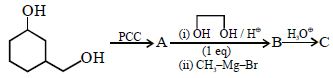
what is $C$ ?
Consider the following statements :-

$(i)$ Increase in concentration of reactant increases the rate of a zero order reaction

$(ii)$ Rate constant $k$ is equal to $'A'$ if $E_a = 0$

$(iii)$ Rate constant $k$ is equal to $'A'$ if $E_a = \infty$

$(iv)$ $log_e k$  vs  $T$ is a straight line

$(v)$ $log_ek$  vs   $1/T$ is straight line
Correct statement are

In the periodic table, metallic character of the elements shows which one of the following trends?
The decomposition of formic acid on gold surface follows first order kinetics. If the rate constant at $300\, K$ is $1.0 \times 10^{-3} s ^{-1}$ and the activation energy $E _{ a }=11.488\, kJ\, mol ^{-1},$ the rate constant at $200\, K$ is ............  $\quad \times 10^{-5} s ^{-1} .$

(Round of to the Nearest Integer).

(Given : $\left. R =8.314\, J\, mol ^{-1} K ^{-1}\right)$

A flask contains a mixture of compounds $A$ and $B.$ Both compounds decompose by first-order kinetics. The half-lives for $A$ and $B$ are $300$ $s$ and $180\, s ,$ respectively. If the concentrations of $A$ and $B$ are equal initially, the time required for the concentration of $A$ to be four times that of $B ($ in $s ):$ (Use $\ln 2=0.693)$


At higher altitude, boiling point of water is $95\,^oC$. The amount of $NaCl$ added to $1\, kg$ of water $(K_b = 0.52\, K\, mol^{-1}\,kg)$ in order to raise the boiling point of solution to $100\,^oC$ (assuming $90\%$ ionisation of $NaCl$) .......... $g$
The process requiring absorption of energy is