Question
p-Block elements form acidic, basic and amphoteric oxides. Explain each property by giving two examples and also write the reactions of these oxides with water.
Answer

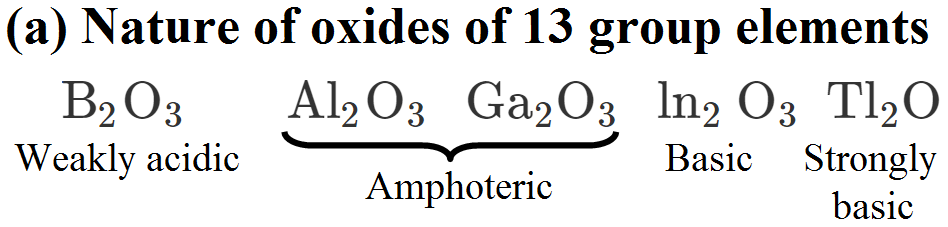
In p-block, when we move from left to right in a period, the acidic character of the oxides increases due to increase in electronegativity. For example,
In $2^{nd}$ period $B_2O_3 < CO_2 < N_2O_3$ (acidic nature increases).
In $3^{rd}$ period $A1_2O_3 < SiO_2 < P_4O_{10} < SO_3 < C1_2O_7$ (acidic character increases).
On moving down the group, acidic character decreases and basic character increases, e.g.,
  1. Nature of oxides of 15 group elements.
$\text{N}_2\text{O}_5\ \ \ \ \ \ \ \ \ \ \ \ \ \ \ \ \ \ \ \ \ \ \text{P}_4\text{O}_{10}\ \ \ \ \ \ \ \ \ \ \ \ \ \ \ \ \ \ \ \text{As}_4\text{O}_{10}\ \ \ \ \ \ \ \ \ \ \text{Sb}_4\text{O}_{10}\ \ \ \ \ \ \ \ \ \ \text{Bl}_2\text{O}_3\\ ^\text{Strongly acidic}\ \ \ \ \ \ \ \ \ ^\text{Moderately acidic}\ \ \ \ \ \ \ \ \ \ \ ^\text{Amphoteric}\ \ \ \ \ \ \ \ ^\text{Amphoteric}\ \ \ \ \ \ \ \ \ \ ^\text{Basic}$
Among the oxides of same element, higher the oxidation state of the element, stronger is the acid. For example, $SO_3$ is a stronger acid than $SO_2$.
$B_2O_3$ is weakly acidic and on dissolution in water, it forms orthoboric acid. Orthoboric acid does not act as a protonic acid (it does not ionise) but acts as a weak Lewis acid.
$\text{B}_2\text{O}_3\ \ \ \ \ \ \ \ \ \ +\ \ \ \ \ \ \ 3\text{H}_2\text{O}\ \ \ \rightleftharpoons\ \ \ \ 2\text{H}_3\text{BO}_3\\^\text{Boron trioxide}\ \ \ \ \ \ \ \ \ \ \ \ \ \ \ \ \ \ \ \ \ \ \ \ \ \ \ \ \ \ \ \ \ \ \ \ ^\text{Orthoboric acid}$
$\text{B(OH)}_3\ +\ \text{H}-\text{OH}\xrightarrow{\ \ \ \ \ \ \ \ \ \ \ \ }\big[\text{B}(\text{OH})_4\big]^{-}+\text{H}^+$
$Al_2O_3$ is amphoteric in nature. It is insoluble in water but dissolves in alkalies and reacts with acids.
$\text{Al}_2\text{O}_3\ \ +\ \ 2\text{NaOH}\ \xrightarrow{\ \ \ \ \ \ \ {\Delta} \ \ \ \ \ \ \ \ }\ 2\text{NaAlO}_2\ \ +\ \ \text{H}_2\text{O}\\ ^\text{Aluminium}\ \ \ \ \ \ \ \ \ \ \ \ \ \ \ \ \ \ \ \ \ \ \ \ \ \ \ \ \ \ \ \ \ \ \ \ \ \ ^\text{Sodium meta}\\ \ \ ^\text{trioxide}\ \ \ \ \ \ \ \ \ \ \ \ \ \ \ \ \ \ \ \ \ \ \ \ \ \ \ \ \ \ \ \ \ \ \ \ \ \ \ \ \ \ \ ^\text{chloride}$
$\text{Al}_2\text{O}_3\ \ +\ \ 6\text{HCl}\ \xrightarrow{\ \ \ \ \ \ \ {\Delta} \ \ \ \ \ \ \ \ }\ 2\text{AlCl}_3\ \ +\ \ 3\text{H}_2\text{O}\\ \ \ \ \ \ \ \ \ \ \ \ \ \ \ \ \ \ \ \ \ \ \ \ \ \ \ \ \ \ \ \ \ \ \ \ \ \ \ \ \ \ \ \ \ \ \ \ \ ^\text{Aluminium}\\ \ \ \ \ \ \ \ \ \ \ \ \ \ \ \ \ \ \ \ \ \ \ \ \ \ \ \ \ \ \ \ \ \ \ \ \ \ \ \ \ \ \ \ \ \ \ \ \ \ \ ^\text{chloride}$
$Tl_2O$ is as basic as NaOH due to its lower oxidation state (+1).
$\text{Tl}_2\text{O}\ +\ 2\text{HCl}\ \xrightarrow{\ \ \ \ \ \ \ \ \ \ \ \ }2\text{TlCl}\ +\ \text{H}_2\text{O}$

Need a full question paper?

Generate a complete, print-ready paper with questions like this in minutes — across 16+ boards, with answer keys.
Start Generating Free

Similar questions

$\mathrm{K}_p=0.04 \mathrm{~atm}$ at 899 K for the equilibrium shown below. What is the equilibrium concentration of $\mathrm{C}_2 \mathrm{H}_6$ when it is placed in a flask at 4.0atm pressure and allowed to come to equilibrium?
$\text{C}_2\text{H}_6(\text{g})\rightleftharpoons\text{C}_2\text{H}_4(\text{g})+\text{H}_2(\text{g})$
Explain various methods to form alkene.
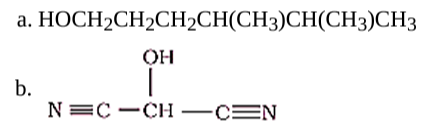
1. For each of the following compounds, write a condensed formula and also their bond-line formula.
Image
2. How does
i. an electron withdrawing group (EWG) and
ii. an electron donating group (EDG) influence the acid strength of carboxylic end?
Neon gas is generally used in the sign boards. If it emits strongly at $616\ nm$, calculate
  1. The frequency of emission.
  2. Distance traveled by this radiation in $30s$.
  3. Energy of quantum.
  4. Number of quanta present if it produces $2J$ of energy.
Starting with sodium chloride how would you proceed to prepare.
  1. Sodium metal
  2. Sodium hydroxide
  3. Sodium peroxide
  4. Sodium carbonate?
Write periodic trends of valency and oxidation state in periodic table
1. During estimation of nitrogen present in an organic compound by Kjeldahl's method, the ammonia evolved from 0.5 g of the compound in Kjeldahl's estimation of nitrogen, neutralized 10 mL of $1 M H _2 SO _4$. Find out the percentage of nitrogen in the compound.
2. Explain why $\left( CH _3\right)_3 \stackrel{+}{ C }$ is more stable than $CH _3 \stackrel{+}{ C } H _2$ and $\stackrel{+}{ C } H _3$ is the least stable cation.
Explain the stability of benzene by resonance and molecular orbital diagram.
Derive the relationship between $\Delta\text{H}$ and $\Delta\text{U}$ for an ideal gas. Explain each term involved in the equation.
Discuss and compare the trend in ionisation enthalpy of the elements of group1 with those of group17 elements.