MCQ
Pairing of electrons in the orbitals belonging to the same subshell $(p, d$ or $f)$ does not take place until each orbital belonging to that subshell is singly occupied. This is called :
  • Hund's rule of maximum multiplicity.
  • B
    Pauli's exclusion principle.
  • C
    Aufbau principle.
  • D
    None of the above.

Answer

Correct option: A.
Hund's rule of maximum multiplicity.
Pairing of electrons in the orbitals belonging to the same subshell $(p, d$ or$f)$ does not take place until each orbital belonging to that subshell has got one electron each, i.e. it is singly occupied. This is called Hund's rule of maximum multiplicity.

Need a full question paper?

Generate a complete, print-ready paper with questions like this in minutes — across 16+ boards, with answer keys.

Start Generating Free

Similar questions

For the reaction $\text{H}_2\text{(g)}+\text{I}_2\text{(g)}\rightleftharpoons2\text{HI(g)},$ the standard free energy is $\Delta\text{G}^\ominus > 0.$ The equilibrium constant $(K)$ would be $ .........$
In the following reaction, the $Cl -P -Cl$ bond angles

$PCl_5 \longrightarrow PCl_4^+ + Cl^-$

Find the value of wave number of $(\bar v)$ in terms of Rydberg's constant, when transition of electron takes place between two levels of $He^+$ ion whose sum is $4$ and difference is $2$
The hybridisations of the atomic orbitals of nitrogen in $\mathrm{NO}_{2}^{-}, \mathrm{NO}^{+} _2$ and $\mathrm{NH}_{4}{ }^{+}$respectively are.
Calculate the wavelength (in nanometer) associated with a proton moving at $1.0 \times 10^3 \,ms^{-1}.$ ........... $\mathrm{nm}$

(Mass of proton $= 1.67 \times 10^{-27}\, kg$ and $h = 6.63 \times 10^{-34}\, Js$)

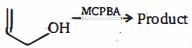
$(MCPBA \to$ meta-chloro perbenzoic acid)
Stereochemistry of the product of above reaction is
The standard enthalpies of formation of $Al _{2} O _{3}$ and $CaO$ are $-1675\, kJ\, mol ^{-1}$ and $-635\, kJ\, mol ^{-1}$ respectively.

For the reaction $3 CaO +2 Al \rightarrow 3 Ca + Al _{2} O _{3}$ the standard reaction enthalpy $\Delta_{ r } H ^{0=}$ .......... $kJ$.

(Round off to the Nearest Integer).

What is the percent ionization $(\alpha)$ of a $0.01\, M\, HA$ solution ? .......$\%$ $(K_a = 10^{-6})$
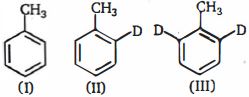
The rate of $o-$ nitration of the above compounds, $(I)$ toluene, $(II)\, 2-D-$ toluene and $(III) \,2, 6-D_2$ -toluene is in the following order
Which of the following is the correct order for increasing bond angle ?