Question
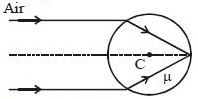
Parallel rays are incident on a transparent sphere along its one diameter. After refrection these rays converge at the other end of this diameter the refractive index of the sphere is

Answer

$\frac{\mu_{2}}{v}-\frac{\mu_{1}}{u}=\frac{\mu_{2}-\mu_{1}}{R}$

$\mathrm{v}=2 \mathrm{R}, \mathrm{u}=\infty, \mathrm{R}=+\mathrm{R}, \mu_{1}=1, \mu_{2}=\mu$

$\frac{\mu}{2 R}-\frac{1}{\infty}=\frac{\mu-1}{R} \Rightarrow \mu=2$
Need a full question paper?

Generate a complete, print-ready paper with questions like this in minutes — across 16+ boards, with answer keys.
Start Generating Free

Similar questions

A ceiling fan having 3 blades of length $80 \mathrm{~cm}$ each is rotating with an angular velocity of $1200\  \mathrm{rpm}$. The magnetic field of earth in that region is $0.5 \ \mathrm{G}$ and angle of dip is $30^{\circ}$. The emf induced across the blades is $N \pi \times 10^{-5} \mathrm{~V}$. The value of $\mathrm{N}$ is
A convex lens is in contact with concave lens. The magnitude of the ratio of their focal length is $2/3.$ Their equivalent focal length is $30 cm.$ What are their individual focal lengths
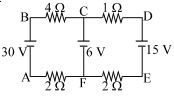
The figure shows a network of four resistances and three batteries Choose the correct alternative
A conducting body $1$ has some initial charge $Q$, and its capacitance is $C$. There are two other conducting bodies, $2$ and $3$, having capacitances : $C_2 = 2C$ and $C_3 \rightarrow \infty$ . Bodies $2 $ and $3 $ are initially uncharged. "Body $2$ is touched with body $1$. Then, body $2$ is removed from body $1 $ and touched with body $3$, and then removed." This process is repeated $N$ times. Then, the charge on body $1$ at the end must be
A source of light emits a continuous stream of light energy which falls on a given area. Luminous intensity is defined as
Water flows out of the hole on the side of a bucket and follows a parabolic path. If the bucket falls freely under gravity, ignoring air resistance, the water flow
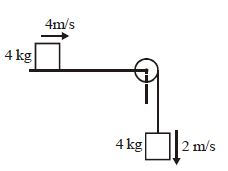
Two blocks of same mass $(4\ kg)$ are placed according to diagram. Initial velocities of bodies are $4\ m/s$ and $2\ m/s$ and the string is taut. Find the impulse on $4\ kg$ when the string again becomes taut  .......... $N-s$
An electron of mass $m$ and a photon have same energy $E.$ The ratio of de-Broglie wavelengths associated with them is
Energy of $10$ non rigid diatomic molecules at temperature $\mathrm{T}$ is :
Let ${n_P}$ and ${n_e}$ be the number of holes and conduction electrons respectively in a semiconductor. Then