MCQ
Particle $A$ is moving along $x$-axis. At time $t=0$, it has velocity of $10\,m / s$ and acceleration $-4\,m / s ^2$. Particle $B$ has velocity of $20\,m / s$ and acceleration $-2\,m / s ^2$. Initially, both the particles are at origin. At time $t=2\,s$, distance between the two particles is $.............\,m$
  • $24$
  • B
    $36$
  • C
    $20$
  • D
    $42$

Answer

Correct option: A.
$24$
a
(a)

At $2 s$

$x_A=10 \times 2-\frac{1}{2} \times 4 \times(2)^2=12\,m$

and $\quad x_B=20 \times 2-\frac{1}{2} \times 2 \times(2)^2$

$=36\,m$

$\therefore$ Distance between $A$ and $B$ at that instant is, $24\,m$.

Need a full question paper?

Generate a complete, print-ready paper with questions like this in minutes — across 16+ boards, with answer keys.

Start Generating Free

Similar questions

The specific heat of alcohol is about half that of water. Suppose you have identical masses of alcohol and water. The alcohol is initially at temperature $T_A$ . The water is initially at a different temperature $T_W$ . Now the two fluids are mixed in the same container and allowed to come into thermal equilibrium, with no loss of heat to the surroundings. The final temperature of the mixture will be 
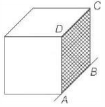
A solid cube of wood of side $2 a$ and mass $M$ is resting on a horizontal surface as shown below. The cube is free to rotate about the fixed axis $A B$. A bullet of mass $m ( < M)$ and speed $v$ is shot horizontally at the face opposite to $A B C D$ at a height $h$ above the surface to impart the cube an angular speed $\omega_{c}$, so that the cube just topples over. Then, $\omega_{c}$ is (Note the moment of inertia of the cube about an axis perpendicular to the face and passing through the centre of mass is $2 M a^{3} / 3$ )
A block of mass $100 \mathrm{~kg}$ slides over a distance of $10 \mathrm{~m}$ on a horizontal surface. If the co-efficient of friction between the surfaces is $0.4$ , then the work done against friction (in $\mathrm{J}$ ) is :
Two bodies $P$ and $Q$ of equal masses are kept at heights $x$ and $4x$ respectively. What will be the ratio of their potential energies?
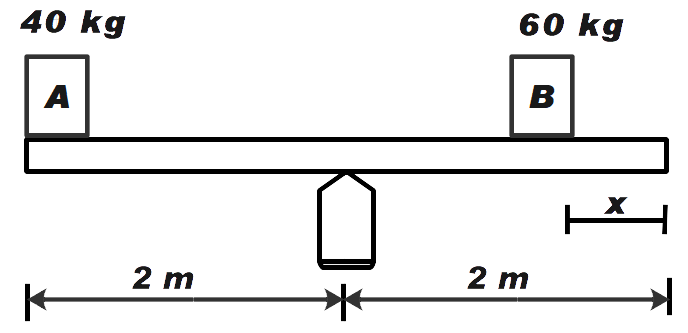
In the game of see$-$saw, what should be the displacement of boy $B$ from right edge to keep the see$-$saw in equilibrium? $(M = 40\ kg, M_2 = 60\ kg.)$
Image
If the mass of sun were ten times smaller and gravitational constant $G$ were ten times larger in magnitudes.
  1. Walking on ground would became more difficult.
  2. The acceleration due to gravity on earth will not change.
  3. Raindrops will fall much faster.
  4. Airplanes will have to travel much faster.
A beaker of radius $15\, cm$ is filled with a liquid of surface tension $0.075\, N/m.$ Force  across an imaginary diameter on the surface of the liquid is:-
A hole diffuses from the p-side to the n-side in a p-n junction. This means that.
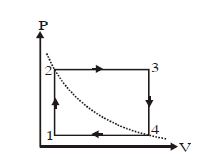
One mole of an ideal gas undergoes a cyclic process, consisting of two isochores and two isobars. Temperature at $1$ and $3$ equal to $T_1$ and $T_3$ respectively. The work done by the gas over the cycle, if the point $2$ and $4$ lie on the same isotherm
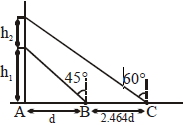
A balloon is moving up in air vertically above a point $A$ on the ground. When it is at a height $h _{1},$ a girl standing at a distance $d$ (point $B$ ) from $A$ (see figure) sees it at an angle $45^{\circ}$ with respect to the vertical. When the balloon climbs up a further height $h _{2},$ it is seen at an angle $60^{\circ}$ with respect to the vertical if the girl moves further by a distance $2.464\, d$ (point $C$ ). Then the height $h _{2}$ is (given tan $\left.30^{\circ}=0.5774\right)$$.......$