MCQ
Passage cells are thin walled cells found in
  • A
    phloem elements that serve as entry points for substance for transport to other plant parts
  • B
    testa of seeds to enable emergence of growing embryonic axis during seed germination
  • C
    central region of style through which the pollen tube grows towards the ovary
  • endodermis of roots facilitating rapid transport of water from cortex to pericycle.

Answer

Correct option: D.
endodermis of roots facilitating rapid transport of water from cortex to pericycle.
d
(d) : Endodermis is a single layered structure which separates cortex from stele. There are both thick walled and thin walled cells in the endodermis. The thin walled cells are known as passage cells or transfusion cells which are opposite the protoxylem groups. These cells help in rapid transport of water from cortex to pericycle.

Need a full question paper?

Generate a complete, print-ready paper with questions like this in minutes — across 16+ boards, with answer keys.

Start Generating Free

Similar questions

An example of ex situ conservation is
Where oxidative phosphorylation is occur ?
Given below are two statements:
Statement I: Gause's 'Competitive Exclusive Principle' states that two closely related species Competing for the Same resources can co-exist indefinitely and competitively inferior one will be eliminated eventually.
Statement II: In general, herbivores are affected by competition than Carnivores more adversely.
Choose the correct answer from option the given below:
Linnaeus system of plant classification is
Read the following and choose the option with all incorrect statements.
(A) Gemmae are green, multicellular, asexual buds, which develop in small receptacles called gemma cups located on the thalli in mosses.
(B) In thallophytes; sporophyte is differentiated into a foot, seta and capsule.
(C) The predominant stage of the life cycle of a liverworts is the gametophyte which consists of two stages.
(D) The first stage is the protonema stage, which develops directly from a spore in mosses.
(E) The second stage is the leafy stage, which develops from the secondary protonema as a lateral bud in mosses.
(F) Sexual reproduction in mosses is by fragmentation and budding in the secondary protonema.
(G) The sporophyte in liverworts is more elaborate than that in mosses.
(H) In bryophytes the dominant phase in the life cycle is the gametophytic plant body.
(I) The sporophytes bear sporangia that are subtended by leaf-like appendages in pteridophytes called sporophylls.
(J) In pteridophytes, multicellular, free living. mostly photosynthetic thalloid gametophytes is called prothallus.
(K) Zygote produces a multicellular well- differentiated sporophyte which is the dominant phase of the Algaes.
(L) The development of the zygotes into young embryos take place within the female gametophytes. This event is a precursor to the seed habit considered an important step in evolution.
(M) The pteridophytes are classified into four classes: Bryopsida: lycopsida; sphenopsida and Pteropsida.
(N) The gymnosperms are plants in which the ovules are not enclosed by any ovary wall and remain exposed both before and after fertilization.
(0) One of the Angiosperm, sequoia is one of the tallest tree species.
Choose the correct option given below :-
Statement I: Electron gradient is important because breakdown of this gradient leads to release of energy
Statement II: The gradient is broken down due to the movement of protons across the thylakoid membrane to the stroma.
Which of the following statements is not correct ?
Gymnosperms lack which of the following structure?
Pinus seed cannot germinate and establish without fungal association. This is because
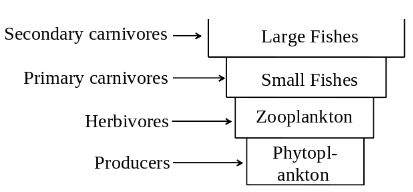
Which kind of pyramid is represented by the given diagram