MCQ
$PC{l_5}$ exists but $NC{l_5}$ does not because
  • Nitrogen has no vacant orbitals
  • B
    $NC{l_5}$ is unstable
  • C
    Nitrogen atom is much smaller
  • D
    Nitrogen is highly inert

Answer

Correct option: A.
Nitrogen has no vacant orbitals
a
(a) $d$ - orbitals are absent in nitrogen.

Need a full question paper?

Generate a complete, print-ready paper with questions like this in minutes — across 16+ boards, with answer keys.

Start Generating Free

Similar questions

A non ideal solution was prepared by mixing $30\,ml$ chloroform and $50\,ml$ acetone. The volume of mixture will be
The freezing point of one molal $NaCl$ solution assuming $NaCl$ to be $100\% $ dissociated in water is  ............ $^oC$. (molal depression constant $= 1.86$)
$Y\, g$ of non-volatile organic substance of molecular mass $M $ is dissolved in $250\,g$ benzene. Molal elevation constant of benzene is $K_b.$ Elevations in it's boiling point is given by -
Which of the following is coloured as well as paramagnetic?
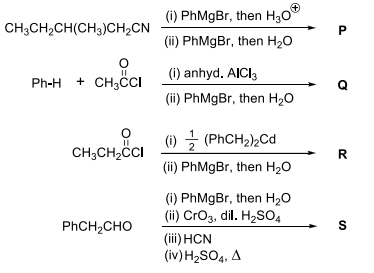
In the following reactions, $P, Q, R$, and $S$ are the major products.

The correct statement($s$) about $P, Q, R$, and $S$ is(are)

($A$) Both $P$ and $Q$ have asymmetric carbon($s$).

($B$) Both $Q$ and $R$ have asymmetric carbon($s$).

($C$) Both $P$ and $R$ have asymmetric carbon($s$).

($D$) $P$ has asymmetric carbon(s), $S$ does not have any asymmetric carbon.
Consider the reaction, $2A + B \rightarrow$ products. When concentration of $B$ alone was doubled, the half-life did not change. When the concentration of $A$ alone was doubled, the rate increased by two times. The unit of rate constant for this reaction is
In nucleuphilic substitution reaction, order of halogens as incoming (attacking) nucleophile is:
$I^-> Br^ - > Cl^-$
The order of halogens as departing nucleophile should be
For the following parallel chain reaction. What will be that value of overall half-life of $A$ in minutes ?

Given that  $\left[ {\frac{{{{\left[ B \right]}_t}}}{{{{[C]}_t}}} = \frac{{16}}{9}} \right]$

$A\,\xrightarrow{{{K_1}\, = \,2\, \times \,{{10}^{^{ - 3}\,}}{S^{ - 1}}}}4B$

$A\to C$

$C{H_3} - C{H_2} - OH\,\xrightarrow[\Delta ]{{C{l_2}\,/\,O{H^\Theta }}}A$ $\xrightarrow[\Delta ]{{Ag}}B\,\xrightarrow[{1\,\% \,\,HgS{O_4}}]{{20\,\,\% \,\,{H_2}S{O_4}\,,\,{H_2}O}}C$

Compound $'C'$ is

Which of the following compounds is not coloured ?