MCQ
PEP is primary CO2 acceptor in:
- AC4 plants.
- BC3 plants.
- CC2 plants.
- DBoth C3 and C4 plants.
Explanation:
Mechanism of C4 pathway (or Dicarboxylic acid pathway or Hatch and Slack pathway) can be illustrated as follows:
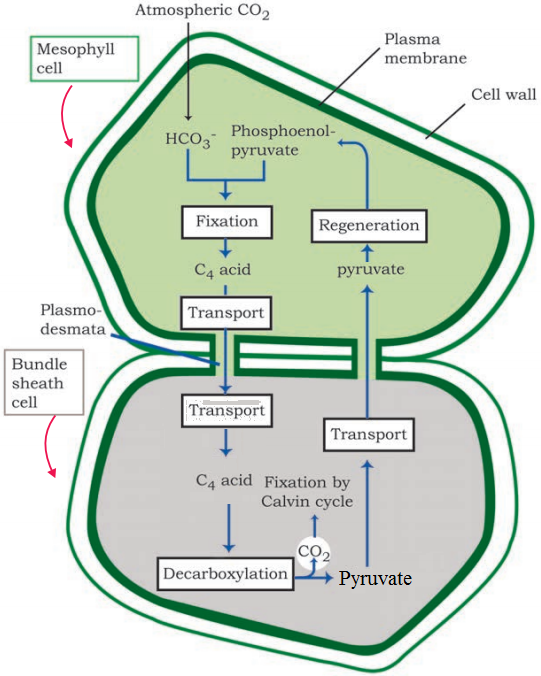
Initial fixation in C4 plants, initial fixation of CO2 or carboxylation occurs in mesophyll cells. The chloroplasts of mesophyll cells possess enzyme PEP carboxylase (or PEP case) for initial fixation of CO2 The primary acceptor of CO2 is phosphoenol pyruvate or PEP It combines with CO2 in the presence of PEP carboxylase (or PEPcase) to form oxaloacetic acid or oxaloacetate (OAA).
$\text{PEP}+\text{CO}_{2}+\text{H}_{2}\text{O}\ {\xrightarrow{\ \ \ \ \ \ \ \ \ \ \ }}\text{OAA}+\text{H}^{3}\text{PO}_{4}$
$\text{Pyruvate}+\text{ATP}+\text{H}_{3}\text{PO}_{4}\ {\xrightarrow{\ \ \ \ \ \ \ \ \ \ \ }}\text{PEP}+\text{AMP}+\text{PPi}$
Generate a complete, print-ready paper with questions like this in minutes — across 16+ boards, with answer keys.
$(A)$ Coenzyme or metal ion that is tightly bound to enzyme protein is called prosthetic group.
$(B)$ A complete catalytic active enzyme with its bound prosthetic group is called apoenzyme.
Select the correct option.