MCQ
Permanent magnets should have:
- AHigh retentivity and low coercivity.
- BLow retentivity and high coercivity.
- CHigh retentivity and high coercivity.
- DLow retentivity and low coercivity.
Explanation:
Permanent magnets should have high retentivity so that a strong magnetic field persists on removal of magnetic field.
Permanent magnets should have high coercivity so that external magnetic field in opposite direction cannot easily demagnetize the magnet.
Generate a complete, print-ready paper with questions like this in minutes — across 16+ boards, with answer keys.
The capacity and the energy stored in a parallel plate condenser with air between its plates are respectively  and
and  . If the air is replaced by glass (dielectric constant = 5) between the plates, the capacity of the plates and the energy stored in it will respectively be
|
(a) |
(b) |
(c) |
(d) |
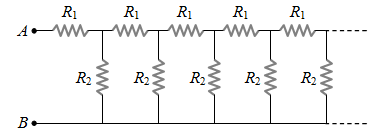
An infinite sequence of resistance is shown in the figure. The resultant resistance between A and B will be, when  and
and 
|
(a) Infinity |
(b) 1 Ω |
(c) 2 Ω |
(d) 1.5 Ω |
A potentiometer consists of a wire of length 4 m and resistance 10Ω. It is connected to a cell of e.m.f. 2 V. The potential difference per unit length of the wire will be
|
(a) 0.5 V/m |
(b) 2 V/m |
(c) 5 V/m |
(d) 10 V/m |
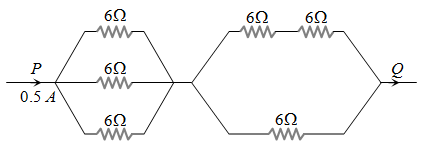
Resistances of 6 ohm each are connected in the manner shown in adjoining figure. With the current 0.5 ampere as shown in figure, the potential difference  is
is
|
(a) 3.6 V |
(b) 6.0 V |
(c) 3.0 V |
(d) 7.2 V |


