Question
$PH_3$ forms bubbles when passed slowly in water but $NH_3$ dissolves. Explain why?

Answer

$PH_3$ forms bubbles means that it's not soluble in water and $NH_3$ completely dissolves because it's soluble in water. Now $NH_3$ can form hydrogen bonds with water i.e. $H_20$ and hence it's completely soluble in water while $PH_3$ can't form hydrogen bonds with water because of large size of phosphorus as compared to Nitrogen.

Need a full question paper?

Generate a complete, print-ready paper with questions like this in minutes — across 16+ boards, with answer keys.
Start Generating Free

Similar questions

$A\ 0.1539$ molal aqueous solution of cane sugar $($mol. mass $=342 \mathrm{~g} \mathrm{~mol}^{-1} )$ has a freezing point of $271\ K$ while the freezing point of pure water is $273.15\ K $. What will be the freezing point of an aqueous solution containing 5 g of glucose $\left(\mathrm{mol}^2\right.$ mass $\left.=180 \mathrm{~g} \mathrm{~mol}^{-1}\right)$ per $100\ g$ of solution?
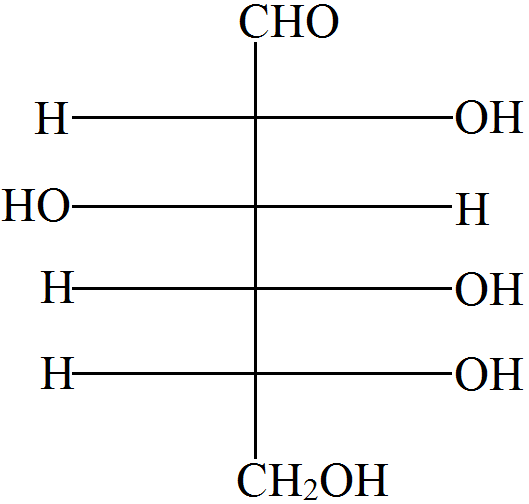
The Fischer projection of D-Glucose is given alongside.
Give the Fischer projection of L-Glucose.
Give reasons:
  1. $PCl_5$ is more covalent than $PCl_3.$
  2. $O-O$ bond has lower bond dissociation enthalpy than S-S bond.
  3. $F_2$ is a stronger oxidising agent than $Cl_{2}.$
  1. What is the radius of sodium atom if it crystallises in bcc structure with the cell edge of $400$ pm?
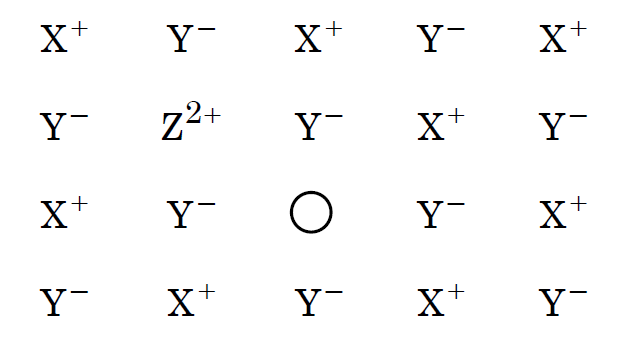
  2. Examine the given defective crystal:
  1. Write the term used for this type of defect.
  2. What is the result when $XY$ crystal is doped with divalent $(Z^{2+})$ impurity?
$i.$ Define rate constant of reaction.
$ii.$ A first order reaction takes $40$ mins for $30\%$ decomposition. Calculate $t_\frac{1}{2}.$
Differentiate between retention and inversion.
Write down the IUPAC name for the following complex and indicate the oxidation state, electronic configuration and coordination number. Also give stereochemistry and magnetic moment of the complex:
$K_4[Mn(CN)_6]$
A solution containing $8$ g of a substance in $100$ g of diethyl ether boils at $36,86^\circ C,$ whereas pure ether boils at $35.60^\circ C$. Determine the molecular mass of the solute. $($For ether $K_b = 2.02\ K\ kg\ mol^{–1}).$
A current of $1.50A$ was passed through an electrolytic cell containing $AgNO_3$ solution with inert electrodes. The weight of Ag deposited was $1.50g$. How long did the current flow?
Explain what is observed when:
  1. KCl, an electrolyte, is added to hydrated ferric oxide sol,
  2. An electric current is passed through a colloidal solution,
  3. A beam of light is passed through a colloidal solution.