MCQ
Phenol associates in benzene to a certain extent for a dimer. A solution containing $20 \times 10^{-3}\,kg$ of phenol in $1\,kg$ of benzene has its freezing point decreased by $0.69\,kelvin$ . ........ $(\%)$ percentage degree of association of phenol. ( $K_f$ for benzene $= 5.12\,K\,kg\,mol^{-1}$ )
  • $60$
  • B
    $85$
  • C
    $73.3$
  • D
    $90.3$

Answer

Correct option: A.
$60$
a
$2A\, \to \,{A_2}$

$1 - \alpha $    $\frac{\alpha }{2}$

$1 - 0.8$    $\frac{{0.8}}{2}$

$i\, = 1 - 0.8\, + \,\frac{{0.8}}{2}\, = \,0.6$

$\Delta {T_f}\, = \,{K_f}\, \times \,\,i\,\, \times \,\,m$ $ = \,5\,\, \times \,0.6\,\, \times \,\frac{X}{{122}}\, \times \,\frac{{1000}}{{30}}\, = \,2$ (Since $\Delta {T_f}\, = \,2$ )

$\therefore \,X\, = \,2.44\,g$

Need a full question paper?

Generate a complete, print-ready paper with questions like this in minutes — across 16+ boards, with answer keys.

Start Generating Free

Similar questions

Which of the following statement is correct with respect to the property of elements in the carbon family with an increase in atomic number, their
Sodium ethoxide is a specific reagent for
The minimum amount of $O_2\,(g)$ consumed per gram of reactant is for the reaction : (Given atomic mass : $Fe = 56,\,\,O = 16,\,\,Mg = 24,\,\,P = 31,\,\,C = 12,\,\,H = 1$ )
Which of the following is(are) example(s) of nucleophilic addition reaction in case of acetylene
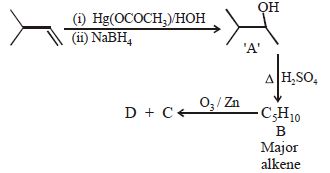
Correct statement regarding above sequence of reaction.
The compound which shows metamerism is :
In the periodic table, the element with atomic number $16$ will be placed in the group
To check the principle of multiple proportions, a series of pure binary compounds $\left(P_m Q_n\right)$ were analyzed and their composition is tabulated below. The correct option($s$) is(are)

Compound Weight $\%$ of $P$ Weight $\%$ of $Q$
$1$ $50$ $50$
$2$ $44.4$ $55.6$
$3$ $40$ $60$

$(A)$ If empirical formula of compound $3$ is $P_3 Q_4$, then the empirical formula of compound $2$ is $P_3 Q_5$.

$(B)$ If empirical formula of compound $3$ is $P _3 Q _2$ and atomic weight of element $P$ is $20$ , then the atomic weight of $Q$ is $45$ .

$(C)$ If empirical formula of compound $2$ is $PQ$, then the empirical formula of the compound $1$ is $P _5 Q _4$.

$(D)$ If atomic weight of $P$ and $Q$ are $70$ and $35$ , respectively, then the empirical formula of compound $1$ is $P _2 Q$.

Select the $CORRECT$ order of stability
If $x$ gram of non-volatile, non-electrolytic solute is dissolved in $114\  g$ octane to reduce its vapour pressure to $80\%$ of that of pure octane then $x$ is ........... $g$. (Molar mass solute $= 40\  g/mole$)