MCQ
Phosphine is not obtained by the reaction
  • A
    White $P$ is heated with $NaOH$
  • Red $P$ is heated with $NaOH$
  • C
    $C{a_3}{P_2}$ reacts with water
  • D
    Phosphorus trioxide is boiled with water

Answer

Correct option: B.
Red $P$ is heated with $NaOH$
b
(b) $\mathop {{P_4}}\limits_{{\rm{Red}}} + NaOH\, \to $ No reaction

Need a full question paper?

Generate a complete, print-ready paper with questions like this in minutes — across 16+ boards, with answer keys.
Start Generating Free

Similar questions

$CH \equiv CH + HBr \to X,$ product $X$ is
The reaction is $C{H_3}CH = C{H_3}\mathop {\xrightarrow{{CO + {H_2}O}}}\limits_{{H^ + }} $  $\begin{array}{*{20}{c}}
  {C{H_3} - CH - C{H_3}} \\ 
  {|\,\,\,\,\,} \\ 
  {\,\,\,\,\,\,\,\,COOH} 
\end{array}$ known as
Suppose two elements $X$ and $Y$ combine to form two compounds $XY_2$ and $X_2Y_3$. If $0.05$ mole of $XY_2$ weighs $5\, g$ while $3.011 \times 10^{23}$ molecules of $X_2Y_3$ weighs $85\, g$, then atomic masses of $X$ and $Y$ are respectively :
Which of these is not a monomer for a high molecular mass silicone polymer ?
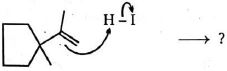
Taking into account the stability of various cycloalkanes and carbocations, as well as the rules governing mechanisms of carbocation rearrangements, what is the most likely product of this reaction ?
For an aqueous solution, the characteristic species of acid is
Match the following

(a) Pure nitrogen (i) Chlorine
(b) Haber process (ii) Sulphuric acid
(c) Contact process (iii) Ammonia
(d) Deacon's process (iv) Sodium azide or Barium azide

Which of the following is the correct option ?

$(a)\quad (b)\quad  (c) \quad (d)$

$\begin{matrix}
   \,\,\,\,\,C{{O}_{2}}H  \\
   | \,\,\,\,\, \,\,\,\\
  \,\,\,\,\, \,\,\,{{(C{{H}_{2}})}_{n}}\,\,\,\,\,\,\,  \\
   | \,\,\,\,\,\, \\
   \,\,\,\,\,C{{O}_{2}}H  \\
\end{matrix}$  

If $(n=4)$ then di-carboxylic acid. would be known as

Four species are listed below :

$i\,\, HCO_3$      $ii. \,H_3O^+$

$iii.\, HSO_4^-$       $iv.\, HSO_3F$

Which one of the following is the correct sequence of their acid strength?

Given below are two statements:

Statement $I$: The boiling point of hydrides of Group $16$ elements follow the order

$\mathrm{H}_2 \mathrm{O}>\mathrm{H}_2 \mathrm{Te}>\mathrm{H}_2 \mathrm{Se}>\mathrm{H}_2 \mathrm{~S}$.

Statement $II$: On the basis of molecular mass, $\mathrm{H}_2 \mathrm{O}$ is expected to have lower boiling point than the othe members of the group but due to the presence of extensive $\mathrm{H}$-bonding in $\mathrm{H}_2 \mathrm{O}$, it has higher boiling point.

In the light of the above statements, choose the correct answer from the options given below: