MCQ
Photoelectric effect can be explained by:
- AWave theory of light.
- BBohr’s theory.
- CQuantum theory of light.
- DCorpuscular theory of light.
Generate a complete, print-ready paper with questions like this in minutes — across 16+ boards, with answer keys.
The force between the plates of a parallel plate capacitor of capacitance C and distance of separation of the plates d with a potential difference V between the plates, is
|
(a) |
(b) |
(c) |
(d) |
A charge q is placed at the centre of the open end of cylindrical vessel. The flux of the electric field through the surface of the vessel is
|
(a) Zero |
(b) |
(c) |
(d) |
The photo-electrons emitted from a surface of sodium metal are such that
|
(a) They all are of the same frequency |
|
(b) They have the same kinetic energy |
|
(c) They have the same de Broglie wavelength |
|
(d) They have their speeds varying from zero to a certain maximum |
Semiconductor is damaged by the strong current due to
|
(a) Lack of free electron |
(b) Excess of electrons |
|
(c) Excess of proton |
(d) None of these |
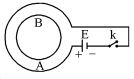
Assertion : Thin films such as soap bubble or a thin layer of oil on water show beautiful colours when illuminated by white light.
Reason : It happens due to the interference of light reflected from the upper surface of the thin film.
|
(a) If both assertion and reason are true and the reason is the correct explanation of the assertion. |
|
(b) If both assertion and reason are true but reason is not the correct explanation of the assertion. |
|
(c) If assertion is true but reason is false. |
|
(d) If the assertion and reason both are false. |
A rod of a certain metal is 1.0 m long and 0.6 cm in diameter. Its resistance is 3.0 ×  ohm. Another disc made of the same metal is 2.0 cm in diameter and 1.0 mm thick. What is the resistance between the round faces of the disc
|
(a) 1.35 × |
(b) 2.70 × |
(c) 4.05 × |
(d) 8.10 × |


