MCQ
Photoelectric effect can be explained by:
- AWave theory of light.
- BBohr’s theory.
- CQuantum theory of light.
- DCorpuscular theory of light.
Generate a complete, print-ready paper with questions like this in minutes — across 16+ boards, with answer keys.
In the forward bias arrangement of a PN-junction diode
|
(a) The N-end is connected to the positive terminal of the battery |
|
(b) The P-end is connected to the positive terminal of the battery |
|
(c) The direction of current is from N-end to P-end in the diode |
|
(d) The P-end is connected to the negative terminal of battery |
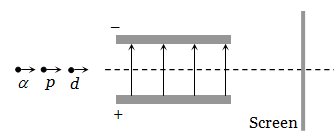
A proton, a deutron and an a-particle having the same momentum, enters a region of uniform electric field between the parallel plates of a capacitor. The electric field is perpendicular to the initial path of the particles. Then the ratio of deflections suffered by them is
|
(a) 1 : 2 : 8 |
(b) 1 : 2 : 4 |
(c) 1 : 1 : 2 |
(d) None of these |
An X-ray tube with a copper target emits Cu  line of wavelength 1.50 Å. What should be the minimum voltage through which electrons are to be accelerated to produce this wavelength of X rays (h = 6.63
|
(a) 8280 V |
(b) 828 V |
(c) 82800 V |
(d) 8.28 V |
In the absence of an electric field, the mean velocity of free electrons in a conductor at absolute temperature (T) is:
Assertion : A narrow pulse of light is sent through a medium. The pulse will retain its shape as it travels through the medium.
Reason : A narrow pulse is made of harmonic waves with a large range of wavelengths.
|
(a) If both assertion and reason are true and the reason is the correct explanation of the assertion. |
|
(b) If both assertion and reason are true but reason is not the correct explanation of the assertion. |
|
(c) If assertion is true but reason is false. |
|
(d) If assertion is false but reason is true. |