Question
Photoelectric effect is the phenomenon in which?

Answer

  1. Which depends on the frequency and intensity of incident light wave.

Need a full question paper?

Generate a complete, print-ready paper with questions like this in minutes — across 16+ boards, with answer keys.
Start Generating Free

Similar questions

A coil of $100$ turns and area $5$ square centimetre is placed in a magnetic field $B = 0.2 T.$ The normal to the plane of the coil makes an angle of $60^\circ$ with the direction of the magnetic field. The magnetic flux linked with the coil is
The capacitance of the capacitor is inversely proportional to:
Silicon is a semiconductor. If a small amount of As is added to it, then its electrical conductivity(a) Decreases(b) Increases(c) Remains unchanged(d) Becomes zero
       
Positive electric flux indicates that electric lines of force are directed:
During a nuclear fusion reaction:
The speed of sound in a medium depends on:
  1. The elastic property but not on the inertia property.
  2. The inertia property but not on the elastic property.
  3. The elastic property as well as the inertia property.
  4. Neither the elastic property nor the inertia property.
The plates of a parallel plate capacitor of capacity $50\ \mu C$ are charged to a potential of $100$  volts and then separated from each other so that the distance between them is doubled. How much is the energy spent in doing so
Consider a long, straight wire of cross-sectional area A carrying a current i. Let there be n free electrons per unit volume. An observer places himself on a trolley moving in the direction opposite to the current with a speed $\text{v}=\frac{\text{i}}{\text{nAe}}$ and separated from the wire by a distance r. The magnetic field seen by the observer is very nearly:
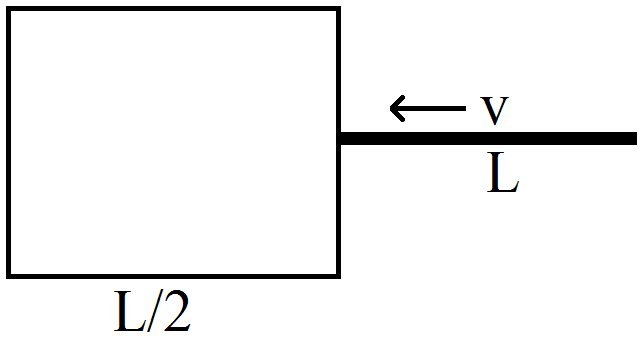
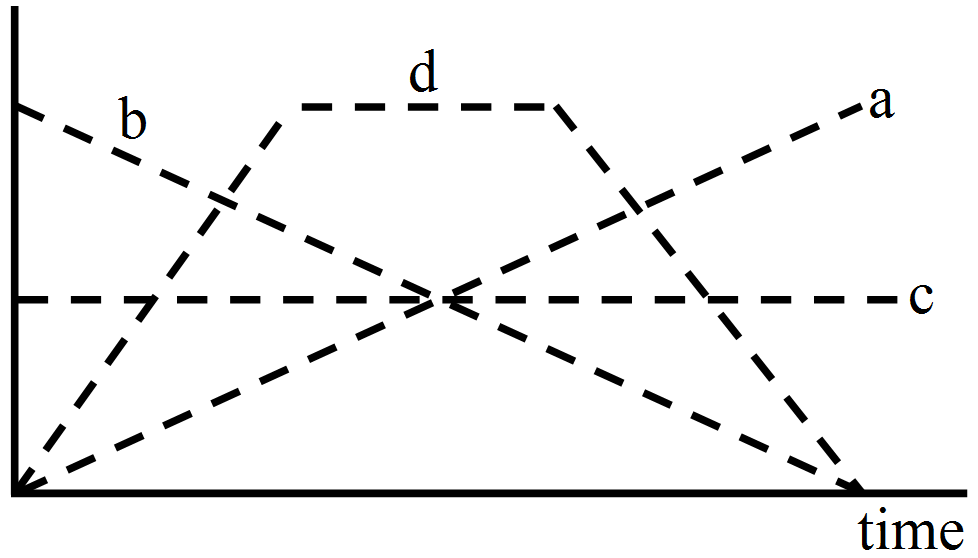
Figure shows an imaginary cube of edge $\frac{\text{L}}{2}.$ A uniformly charged rod of length L moves towards left at a small but constant speed u. At t = 0, the left end just touches the centre of the face of the cube opposite it. Which of the graphs shown in figure represents the flux of the electric field through the cube as the rod goes through it?

  1. a
  2. b
  3. c
  4. d
The force of viscosity is:
  1. Electromagnetic.
  2. Gravitational.
  3. Nuclear.
  4. Weak.