MCQ
Photoelectric effect proves that light wave :
- Aare transverse waves
- ✓have quantum nature
- Chave dual nature
- Dare electromagnetic waves
Generate a complete, print-ready paper with questions like this in minutes — across 16+ boards, with answer keys.
Figure shows three points A, B and C in a region of uniform electric field  . The line AB is perpendicular and BC is parallel to the field lines. Then which of the following holds good. Where
  and
and  represent the electric potential at points A, B and C respectively

|
(a) |
(b) |
(c) |
(d) |
The dimension of (1/2)  : permittivity of free space; E : electric field) is
|
(a) |
(b) |
(c) |
(d) |
The wavelength  of the
  line of characteristic X-ray spectra varies with atomic number approximately
(a)
|
(b) 
|
(c) 
|
(d)  
|
Temperature above which a ferromagnetic substance becomes paramagnetic is called
| (a) Critical temperature | (b) Boyle's temperature |
| (c) Debye's temperature | (d) Curie temperature |
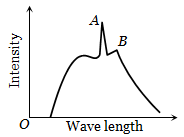
The figure represents the observed intensity of X-rays emitted by an X-ray tube as a function of wavelength. The sharp peaks A and B denote
|
(a) Band spectrum |
(b) Continuous spectrum |
|
(c) Characteristic radiations |
(d) White radiations |
The apparent vertical shift of the image of a coin placed at the bottom of a water tank having constant depth of water is proportional to (given refractive index of water = $\mu$).


