MCQ
Photoelectric effect shows:
  • A
    Wave like behaviour of light.
  • Paritcle like behaviour of light.
  • C
    Both wavelike and paticle like behaviour.
  • D
    Neither wave like nor particle like behaviour of light.

Answer

Correct option: B.
Paritcle like behaviour of light.

Need a full question paper?

Generate a complete, print-ready paper with questions like this in minutes — across 16+ boards, with answer keys.
Start Generating Free

Similar questions

The mass of an atomic nucleus is less than the sum of the masses of its constituents. This mass defect is converted into?
In hydrogen atom which quantity is integral multiple of $\frac{h}{2\pi}$
Sum of the two binary numbers $(10000)_2$ and $(11011)_2$ is
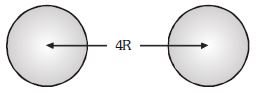
Two identical spheres each of radius $R$ are kept at center-to-center spacing $4R$ as shown in the figure. They are charged and the electrostatic force of interaction between them is first calculated assuming them point like charges at their centers and the force is also measured experimentally. The calculated and measured forces are denoted by $F_c$ and $F_m$ respectively.
($F_c$ and $F_m$ denote magnitude of force)
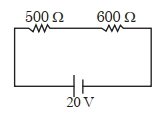
Two resistors are connected in series across a battery as shown in figure. If a voltmeter of resistance $2000 \,\Omega$ is used to measure the potential difference across $500 \,\Omega$ resister, the reading of the voltmeter will be ............... $V$
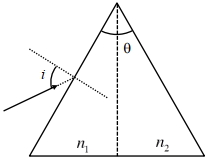
For a prism of prism angle $\theta=60^{\circ}$, the refractive indices of the left half and the right half are, respectively, $n_1$ and $n_2\left(n_2 \geq n_1\right)$ as shown in the figure. The angle of incidence $i$ is chosen such that the incident light rays will have minimum deviation if $n_1=n_2=n=1.5$. For the case of unequal refractive indices, $n_1=n$ and $n_2=n+\Delta n$ (where $\Delta n \ll n$ ), the angle of emergence $e=i+\Delta e$.

Which of the following statement($s$) is (are) correct?

$(A)$ The value of $\Delta e$ (in radians) is greater than that of $\Delta n$

$(B)$ $\Delta e$ is proportional to $\Delta n$

$(C)$ $\Delta e$ lies between 2.0 and 3.0 milliradians, if $\Delta n=2.8 \times 10^{-3}$

$(D)$ $\Delta e$ lies between 1.0 and 1.6 milliradians, if $\Delta n=2.8 \times 10^{-3}$
A cell of internal resistance $r$ drives current through an external resistance $R$ . The power delivered by the cell to the external resistance will be maximum when:
Two lenses of focal lengths $+100\ cm$ and $+5\ cm$ are used to prepare an astronomical telescope. The minimum tube length will be : $($final image is at $ \infty )$
$1$ nano farad $=$
Assertion : $X-$ ray travel with the speed of light.

Reason : $X-$ rays are electromagnetic rays