MCQ
Photoelectric effect was discovered by:
  • Hertz.
  • B
    Hallwachs.
  • C
    Lenard.
  • D
    Millikan.

Answer

Correct option: A.
Hertz.

Need a full question paper?

Generate a complete, print-ready paper with questions like this in minutes — across 16+ boards, with answer keys.
Start Generating Free

Similar questions

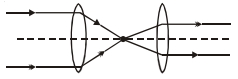
Ray diagram for two lenses kept at some distance given in the diagram, which of the following option is correct $\left(f_1, f_2=\right.$ focal length, $d=$ distance between lenses $)$
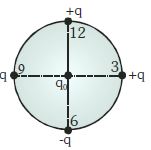
Four charges are placed at the circumference of the dial of a clock as shown in figure. If the clock has only hour hand, then the resultant force on a positive charge $q_0$ placed at the centre, points in the direction which shows the time as 
Assertion : The electrostatic force between the plates of a charged isolated capacitor decreases when dielectric fills whole space between plates.

Reason : The electric field between the plates of a charged isolated capacitance increases when dielectric fills whole space between plates.
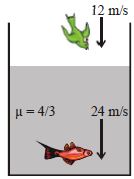
A fish and a bird are moving as shown in figure. Find the velocity of bird as observed by fish.
The potential difference in open circuit for a cell is 2.2 volts. When a 4 ohm resistor is connected between its two electrodes the potential difference becomes 2 volts. The internal resistance of the cell will be
The ratio of intensities of two waves is $9 : 1$. They are producing interference. The ratio of maximum and minimum intensities will be
Monochromatic light is refracted from air into the glass of refractive index μ. The ratio of the wavelength of incident and refracted waves is
A beam of light consisting of two wavelengths $650\, nm$ and $520\, nm$ is used to illuminate the slit of a Young’s double slit experiment. Then the order of the bright fringe of the longer wavelength that coincide with a bright fringe of the shorter wavelength at the least distance from the central maximum is
It is essential to consider light as a stream of photons to explain:
A current passes through a resistor. Let $\mathrm{K}_1$ and $\mathrm{K}_2$ represent the average kinetic energy of the conduction electrons and the metal ions, respectively :