MCQ
Photoelectric emmision occurs only when the incident light has more than a certain minimum?
  • A
    Power.
  • B
    Wavelength.
  • C
    Intensity.
  • Frequency.

Answer

Correct option: D.
Frequency.

Need a full question paper?

Generate a complete, print-ready paper with questions like this in minutes — across 16+ boards, with answer keys.
Start Generating Free

Similar questions

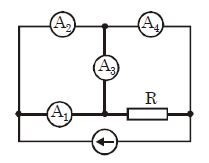
Four ammeters with identical internal resistances $r$ and a resistor of resistance $R$ are connected to a current source as shown in figure. It is known that the reading of the ammeter $A_1$ is $I_1 = 3\ A$ and the reading of the ammeter $A_2$ is $I_2 = 5\ A$ . Determine the ratio of the resistances $R/r$ .
A spring-mass system occillates in a car. if the car accelerates on a horizontal road, the frequency of oscillation will:
A capacitor of capacitance $100\  \mu \mathrm{F}$ is charged to a potential of $12  \mathrm{~V}$ and connected to a $6.4 \ \mathrm{mH}$ inductor to produce oscillations. The maximum current in the circuit would be :
The molecules in which centres of positive and negative charges coincide are called as:
Which of the following rays has the maximum frequency
At sun rise or sunset, the sun looks more red than at mid-day because
A parallel beam of monochromatic light is incident at one surface of a equilateral prism. Angle of incidence is $55^o $  and angle of emergence is $46^o .$ The angle of minimum deviation will be
A particle of charge q and mass m moves in a circular orbit of radius r with angular speed ω. The ratio of the magnitude of its magnetic moment to that of its angular momentum depends on
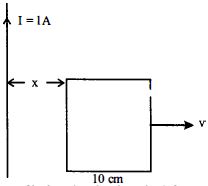
A square frame of side $10\, cm$ and a long straight wire carrying current $1\, A$ are in the plate of the paper. Starting from close to the wire, the frame moves towards the right with a constant speed of $10\, ms^{-1}$ (see figure). The $e.m. f$ induced at the time the left arm of the frame is at $x\, = 10\, cm$ from the wire is .....$\mu V$
A particle of mass $\mathrm{m}$ and charge $\mathrm{q}$ is released from rest in a uniform electric field. If there is no other force on the particle, the dependence of its speed $v$ on the distance $x$ travelled by it is correctly given by (graphs are schematic and not drawn to scale)