- A${K_2}\left[ {PtC{l_6}} \right]$
- ✓$\left[ {Co{{\left( {N{H_3}} \right)}_3}{{(N{O_2})}_3}} \right]$
- C${K_4}\left[ {Fe{{\left( {CN} \right)}_6}} \right]$
- D$\left[ {Cu{{\left( {N{H_3}} \right)}_4}} \right]S{O_4}$
$\left[ Co \left( NH _{3}\right)_{3}\left( NO _{2}\right)_{3}\right]=$ out of the coordination sphere no ions (non ionisable) $K_{4}\left[F e(C N)_{6}\right]=5$ ions
$\left[ Co \left( NH _{3}\right)_{4}\right] . SO _{4}=2$ ions
More ions $\propto$ more conductivity
Generate a complete, print-ready paper with questions like this in minutes — across 16+ boards, with answer keys.
$Cr_2O_7^{2-}$ ( $aq$ $1\,M$ ) $+ 14H^+(aq) + 6e^-$ $\rightarrow 2Cr^{+3} (aq,\,1\,M) + 7H_2O (l)$
$^{200}X \,:\, 90\%$ $^{199}X\, :\, 8.0\%$ $^{202}X\, :\, 2.0\%$
The weighted average atomic mass of the naturally occurring element $X$ is closest to......$amu$
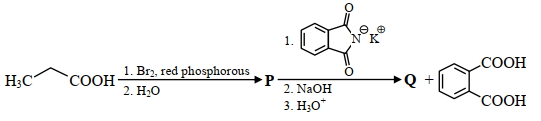
$(A)$ $P$ can be reduced to a primary alcohol using $NaBH _4$.
$(B)$ Treating $P$ with conc. $NH _4 OH$ solution followed by acidification gives $Q$.
$(C)$ Treating $Q$ with a solution of $NaNO _2$ in aq. $HCl$ liberates $N _2$.
$(D)$ $P$ is more acidic than $CH _3 CH _2 COOH$.