MCQ
Pick out the electromagnetic wave which is highly harmful to humans.
  • A
    Radio waves
  • Ultraviolet Rays
  • C
    Microwaves
  • D
    Infrared Waves

Answer

Correct option: B.
Ultraviolet Rays

Ultraviolet $(UV)$ radiations in large quantities are highly harmful to humans. These rays in solar radiation on reaching earth are absorbed by the ozone layer in the atmosphere. $UV$ rays are produced by special lamps such as mercury and from arc lamps and by very hot bodies like the sun.

Need a full question paper?

Generate a complete, print-ready paper with questions like this in minutes — across 16+ boards, with answer keys.
Start Generating Free

Similar questions

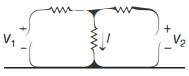
Two batteries $V_1$ and $V_2$ are connected to three resistors as shown below. If $V_1=2 \,V$ and $V_2=0 \,V$, then the current $I=3 \,mA$. If $V_1=0 \,V$ and $V_2=4 \,V$, then the current $I=4 \,mA$. Now, if $V_1=10 \,V$ and $V_2=10 \,V$, then the current $I$ will be ............ $\,mA$
A charge of $5\,C$ is given a displacement of $0.5\,m$. The work done in the process is $10\,J$. The potential difference between the two points will be.......$V$
Ratio of the wavelengths of first line of Lyman series and first line of Balmer series is
A thin convex lens made from crown glass $\left( {\mu = \frac{3}{2}} \right)$ has focal length $f$. When it is measured in two different liquids having refractive indices $\frac{4}{3}$ and $\frac{5}{3}$ it has the focal lengths $f_1$ and $f_2$ respectively. The correct relation between the focal lengths is:
When a charge of 3 coulombs is placed in a uniform electric field, it experiences a force of 3000 Newton. Within this field, potential difference between two points separated by a distance of 1 cm is
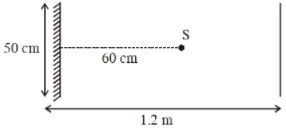
A point source of light $S$, placed at a distance $60 \,cm$ infront of the centre of a plane mirror of width $50 \,cm$, hangs vertically on a wall. A man walks infront of the mirror along a line parallel to the mirror at a distance $1.2\, m$ from it (see in the $figure$). The distance between the extreme points where he can see the image of the light source in the mirror is $\ldots \ldots \ldots\, cm.$
Which one is correct relation for thermionic emission
A parallel plate capacitor of plate area A has a charge Q. The force on each plate of the capacitor is
In total internal reflection when the angle of incidence is equal to the critical angle for the pair of media in contact, what will be angle of refraction.......$^o$ ?
Assertion : In a cavity within a conductor, the electric field is zero.

Reason : Charges in a conductor reside only at its surface