MCQ
Pick out the temperature at which iron becomes paramagnetic?
  • $800^\circ C$
  • B
    $700^\circ C$
  • C
    $600^\circ C$
  • D
    $500^\circ C$

Answer

Correct option: A.
$800^\circ C$
Iron is a ferromagnetic material. Ferromagnetism decreases with a rise in temperature, and above a certain temperature called “Curie’s temperature,” ferromagnets become paramagnets. For iron, it is approximately, $800^\circ C.$

Need a full question paper?

Generate a complete, print-ready paper with questions like this in minutes — across 16+ boards, with answer keys.
Start Generating Free

Similar questions

Finger prints on a piece of paper may be detected by sprinkling fluorescent powder on the paper and then looking it into
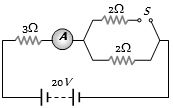
In the circuit shown, the reading of ammeter when switch $S$ is open and when switch $S$ is closed respectively are
Pick out the correct increasing order of energy of electromagnetic waves from the following:
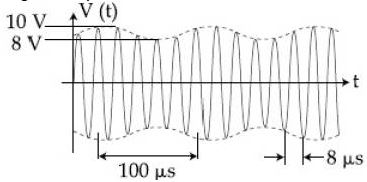
An amplitude modulated signal is plotted below Which one of the following best described the above signal?
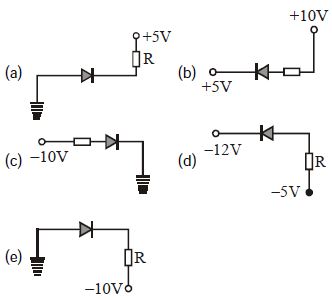
In the given figure, which of the diodes are forward biased
Force of interaction between two co-axial short electric dipoles whose centres are $R$ distance apart varies as
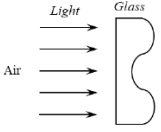
A parallel beam of light strikes a piece of transparent glass having cross section as shown in the figure below. Correct shape of the emergent wavefront will be (figures are schematic and not drawn to scale)-
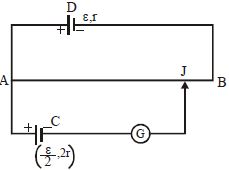
In the figure, the potentiometer wire $AB$ of length $L$ and resistance $9r$ is joined to the cell $D$ of $emf$ $\varepsilon $ and internal resistance $r$. The cell $C's$ $emf$ is $\frac{\varepsilon }{2}$and its internal resistance is $2r$. The galvanometer $G$ will show no deflection when the length $AJ$ is
Which of the following is the disadvantage of FM over AM
Two very long, straight and parallel wires carry steady currents $I$ and $I$ respectively. The distance between the wires is $d$. At a certain instant of time, a point charge $q$ is at a point equidistant from the two wires in the plane of the wires. Its instantaneous velocity $v$ is perpendicular to this plane. The magnitude of the force due to the magnetic field acting on the charge at this instant is