Question
Planck constant has the same dimensions as:

Answer

  1. Force × distance × time.
Explanation:
Planck's constant
$\text{h}=\frac{\text{E}}{\text{v}}=\frac{\text{Force}\times\text{distanace}}{\text{frequency}}$
$\Rightarrow\text{h}=\text{force}\times\text{distance}\times{\text{times}}.$

Need a full question paper?

Generate a complete, print-ready paper with questions like this in minutes — across 16+ boards, with answer keys.
Start Generating Free

Similar questions

Electromagnets are made of soft iron because soft iron has:
Albert Einstein got a nobel prize in physics for his work on:
If the critical angle for total internal reflection from a medium to vacuum is $30^\circ ,$ the velocity of light in the medium is
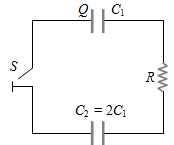
Two capacitors $C_1$ and $C_2 = 2C_1$ are connected in a circuit with a switch between them as shown in the figure. Initially the switch is open and $C_1$ holds charge $Q.$ The switch is closed. At steady state, the charge on each capacitor will be
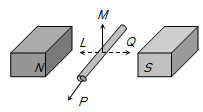
An electric potential difference will be induced between the ends of the conductor shown in the diagram, when the conductor moves in the direction
The force that a unit positive charge would experiences if placed at that point is called as _____ due to charge at a point in space.
Which of the following statement is correct(a) Liquids obey fully the ohm's law(b) Liquids obey partially the ohm's law(c) There is no relation between current and p.d. for liquids(d) None of the above


A metal block is exposed to beams of X-ray of different wavelength. X-rays of which wavelength penetrate most?
Two photons, each of energy 2.5 eV are simultaneously incident on the metal surface. If the work function of the metal is 4.5 eV, then from the surface of the metal:
A radio receiver antenna that is $2 m$ long is oriented along the direction of the electromagnetic wave and receives a signal of intensity $5 \times 10^{-16} W/m^2$. The maximum instantaneous potential difference across the two ends of the antenna is